
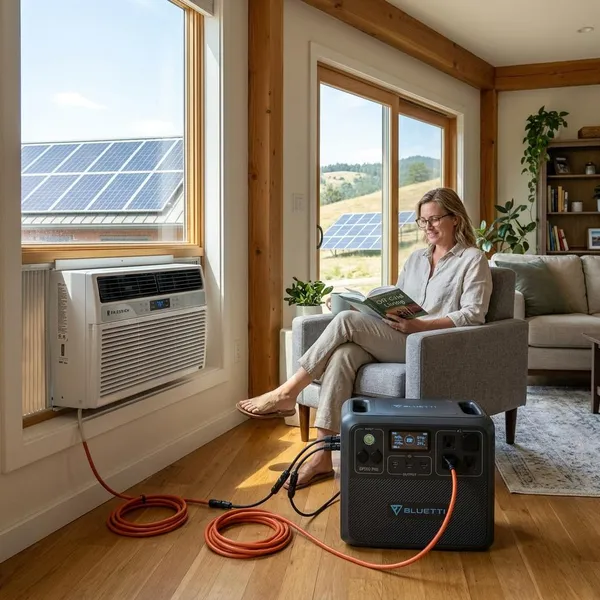
A solar generator can power an air conditioner when its inverter is strong enough to handle the compressor's startup surge and its battery has enough capacity to keep the unit running for a practical amount of time. Small window AC units, efficient portable ACs, and RV air conditioners are the most realistic options; running central air for an entire home requires a much larger solar and battery setup.
How Does a Solar Generator Run an Air Conditioner?
A solar generator runs an AC through three jobs: the inverter delivers usable household-style power, the battery stores the energy, and the solar panels refill that battery when there is enough sun. If one of those parts is too small, the setup may still turn on briefly but fail when the compressor starts cycling or the room gets hot.
The inverter powers the AC unit
The inverter is the part that decides whether the air conditioner can start and keep running without tripping the solar generator. Running watts matter, but compressor surge is often the deal-breaker: a unit that runs at 700 watts may need far more for a split second when it starts.
- Continuous output: should be comfortably above the AC's normal running load.
- Surge output: should handle compressor startup, especially on older or non-inverter AC units.
- Waveform: a pure sine wave inverter is usually the safer choice for compressor-based appliances.
The battery supplies energy for cooling
The battery decides runtime. A 2,000Wh battery running a 500W AC looks like four hours on paper, but real use is usually shorter because of inverter losses, heat, compressor cycling, and usable battery limits.
This is where many setups disappoint. If you need one bedroom cool for a short afternoon outage, a moderate battery may be enough. If you expect the same system to keep an RV cool overnight in July, the battery requirement changes completely.
Which Air Conditioners Work Best With Solar Generators?
The best air conditioner for a solar generator is usually the smallest efficient unit that cools the space you actually need. Cooling one bedroom, office, camper, or sleeping area is far more realistic than trying to maintain normal comfort across an entire house.
Use the AC type as a first filter before comparing generator models:
| AC type | Best use case | Main sizing concern |
|---|---|---|
| Small window AC | One room or emergency sleeping area | Battery runtime |
| Portable AC | Flexible temporary cooling | Higher running watts |
| RV AC | Mobile cooling and boondocking | Startup surge |
| Mini-split | Efficient zoned cooling | Voltage and system sizing |
| Central AC | Whole-home backup | Very high output and storage |
Small window AC units need less power
Small window units are often the most practical match because they cool a limited area and usually draw less power than portable or central systems. A compact 5,000 to 8,000 BTU model may be realistic for a properly sized portable power station, especially if it is an efficient inverter-style unit.
This is the setup that makes sense for a "cool one room and close the door" plan. During an outage, keeping one bedroom livable is usually a better battery strategy than trying to cool open living spaces.
Portable AC units fit moderate backup needs
Portable AC units can work, but they often use more energy than buyers expect. Many are chosen because they are easy to move, not because they are the most efficient way to cool a room.
If you rent, cannot install a window unit, or need temporary cooling in different rooms, a portable AC may still be worth sizing for. Just be stricter with the numbers: check real running watts, exhaust setup, and how quickly the room heats back up.
What Size Solar Generator Do Different AC Units Need?
Sizing should start with the appliance, not the generator advertisement. The four numbers that matter are running watts, startup watts, battery watt-hours, and solar input watts.
A simple planning order works well: first confirm the inverter can start the AC, then estimate how many cooling hours the battery can actually support, then decide whether solar input is strong enough to help during the day.
Small AC units work with compact systems
A small room AC may pair with a compact or mid-size solar generator if the inverter has enough headroom for startup. In practical terms, many people look at systems around the 1,000W to 1,500W inverter class for smaller units, but the AC's actual surge requirement can change that.
For runtime, a battery around 1,000Wh to 2,000Wh may provide a few useful hours with an efficient small unit in a shaded, closed room. In a hot garage or sunny RV, expect less.
Medium AC units need larger batteries
Medium window or portable units can push a setup into a much larger battery range. If the AC draws around 900 to 1,200 watts while running, a small power station may drain so quickly that the setup is technically compatible but not very helpful.
A practical question is not "Can it turn on?" but "Will it cool long enough to matter?" For a hot evening outage, one hour of runtime may feel very different from four dependable hours.
RV AC units need strong surge support
For RV rooftop AC, do not size only by running watts. Startup surge, soft-start compatibility, battery bank size, and solar roof space all affect the result.
- Check the AC label first: note voltage, amps, running watts if listed, and model details.
- Confirm surge handling: especially if no soft-start is installed.
- Plan for the use case: a short daytime cooldown needs less battery than overnight comfort.
- Reduce the cooling load: shade, window covers, and a reasonable thermostat can add real runtime.
How Long Can a Solar Generator Run an Air Conditioner?
Runtime depends on usable battery capacity, the AC's average power draw, solar charging, room conditions, and thermostat setting. A rough estimate is usable watt-hours divided by average watts, then reduced for real-world losses.
For example, a 2,000Wh system running an AC that averages 700 watts might look like nearly three hours before losses. If the room is poorly insulated or the compressor runs constantly, that number can drop noticeably.
Battery-only use provides limited cooling time
With no solar charging, the battery is the whole fuel tank. This works best for short outages, quick cooldowns, or a few hours of sleeping comfort in one closed room.
If you need cooling through a long summer night, battery-only use requires a much larger setup than many first-time buyers expect.
Solar charging extends daytime runtime
Daytime solar can turn a short cooling session into a more useful one, especially during the hottest afternoon hours. The key is whether the panels are replacing a meaningful share of what the AC is using.
A homeowner using a small window AC in a shaded bedroom may see solar stretch the battery noticeably. An RV parked in full sun with a rooftop AC working hard may still drain the battery even while panels are producing.
What Causes AC and Solar Generator Setups to Fail?
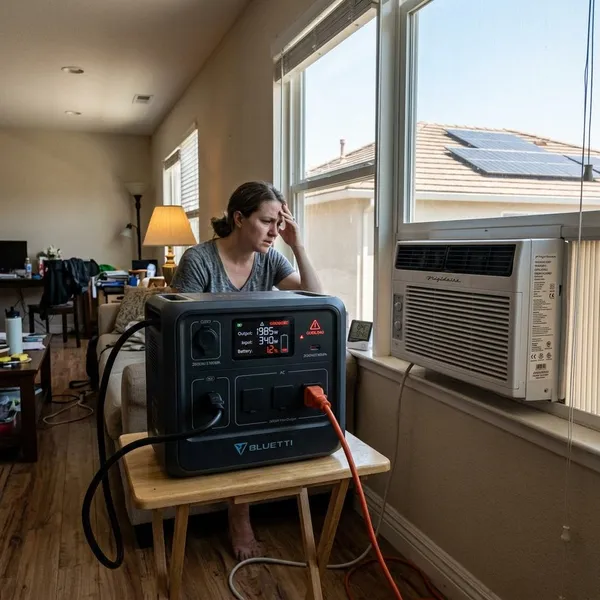
Most failed setups come from focusing on one number and ignoring the others. A strong inverter with a tiny battery is frustrating, a big battery with weak surge support may not start the compressor, and a large solar array cannot help much if it is shaded or poorly matched.
Before buying anything, compare the AC's needs against the generator's continuous output, surge output, usable watt-hours, maximum solar input, and outlet voltage. That five-point check catches most bad matches early.
Low inverter power causes shutdowns
A low-output inverter may shut down as soon as the compressor starts, even if the AC's running watts look acceptable. This is common with older room units, RV rooftop ACs, and larger portable models.
Leave headroom instead of sizing right at the limit. Hot weather can make compressor starts harder, which is exactly when you most need the system to work.
Small batteries shorten cooling time
A small battery can make a setup feel useless even when the AC starts perfectly. If the unit only runs for 45 minutes, it may not solve the actual comfort problem.
This matters most when you are buying for emergency use. For a brief outage, short runtime may be fine; for repeated summer outages or overnight sleep, battery capacity becomes the main investment.
Weak solar input slows recharging
Weak solar input does not usually stop the AC immediately, but it can make the system hard to recover between cooling sessions. Too few panels, partial shade, poor angle, and unrealistic peak-watt expectations are common causes.
If your plan depends on using AC again the next afternoon, recharge speed matters almost as much as first-day runtime.
When Is a Solar Generator a Good Choice for AC?
A solar generator is a good choice when the goal is practical, targeted cooling rather than unlimited air conditioning. It is strongest for one-room comfort, mobile use, short outages, and quieter backup power where fuel generators are inconvenient.
It is a weaker choice when you need whole-home cooling for many hours, have no reliable way to recharge, or are dealing with a high-risk heat situation where failure is not acceptable.
It works well for portable cooling needs
Portable cooling is where solar generators make the most sense. A renter cooling one bedroom, a camper cooling a sleeping area, or someone working in a small shed can often get real value from a matched AC and battery system.
The practical strategy is to cool the occupied space, not every space. Close doors, reduce sun exposure, and avoid setting the thermostat lower than needed.
It helps during short outages
For short outages, a solar generator can keep one room livable without fuel, fumes, or engine noise. That can be enough for sleep, remote work, or getting through the hottest part of the afternoon.
If outages in your area are usually brief, you may not need a whole-home solution. A smaller, well-planned cooling zone can be easier to afford, store, and actually use.
Larger backup systems suit heavy cooling loads
Heavy cooling loads need a more serious backup plan: larger batteries, higher inverter output, strong solar input, and sometimes professional electrical integration. That can make sense for off-grid cabins, larger RVs, or homes where cooling is part of a broader energy system.
For most people, the smarter question is how much cooling is essential. Once you define the room, hours, and risk level, the right system size becomes much clearer.
Conclusion
A solar generator is a realistic way to run an air conditioner when the load is targeted and the system is sized around startup surge, usable battery capacity, and real charging conditions. If you only need one cool room or a few hours of RV comfort, it can be a practical backup; if you expect central air to run like normal grid power, plan on a much larger and more expensive system.