
For most homes, the better choice is not simply the battery with the higher or lower voltage. High-voltage systems usually suit larger, more integrated setups, while low-voltage batteries often make sense for modular storage, essential backup, or staged upgrades. The first things to check are your inverter, the loads you want to support, and whether you may expand the system later.
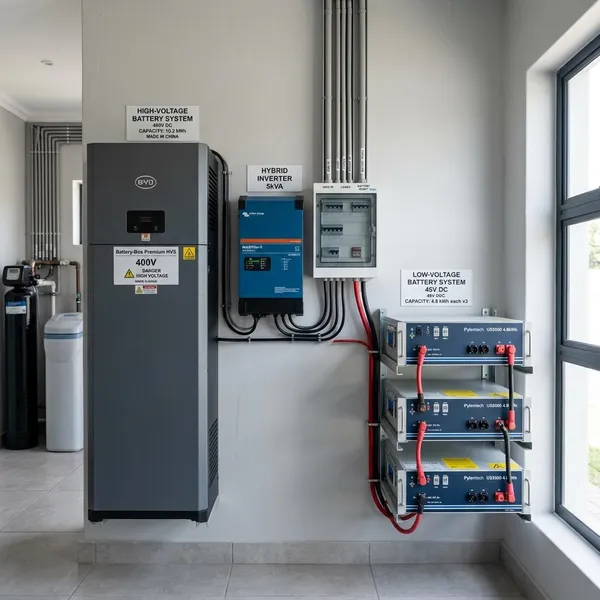
What Are High-Voltage and Low-Voltage Batteries?
Battery voltage describes the operating range between the battery and the inverter. It affects current, wiring, inverter choice, heat management, and how easily the system can be expanded. It does not tell you, by itself, how many hours the battery will run your home.
High-voltage batteries use higher voltage for energy storage
High-voltage home batteries operate at a higher DC voltage and are usually paired with inverters designed for that range. Because the voltage is higher, the system can deliver the same power with less current, which can reduce cable losses and support cleaner system design.
This type often appears in newer integrated solar-plus-storage platforms. It can be a good fit for a larger home, a bigger hybrid inverter, or a household that wants to back up more than just lights, internet, and refrigeration.
Low-voltage batteries use lower voltage with higher current
Low-voltage batteries, often in the 48V class, use a lower operating voltage and higher current for the same power output. They are common in modular battery banks, off-grid-style setups, and retrofit projects where flexibility matters.
The trade-off is practical rather than mysterious: lower voltage can make the system familiar and expandable, but the higher current means cable sizing, fuses, terminals, and installation quality need real attention.
Battery voltage affects system design and performance
Voltage changes how the whole storage system is built. For the same power demand, a lower-voltage system has to move more current, which can increase heat and cable losses if the design is weak. A higher-voltage system may reduce those losses, but only if the inverter, battery management system, and installation are properly matched.
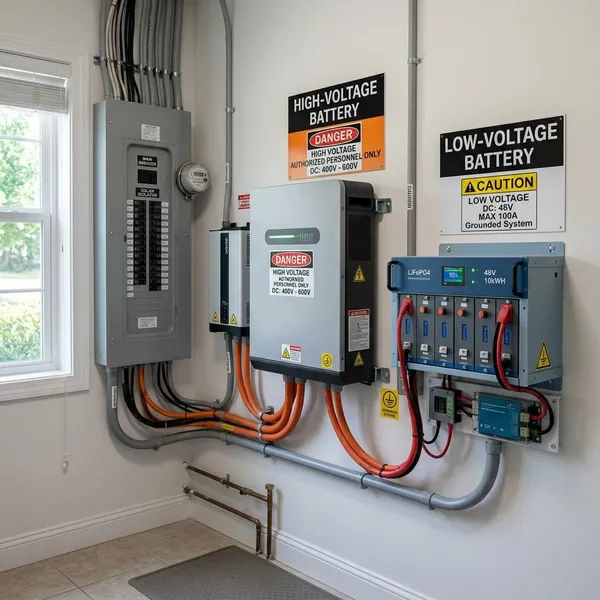
Which Battery Type Is Safer for Home Use?
Both battery types can be safe in a home when the system is certified, protected, and installed correctly. Voltage matters, but it is not the whole safety story. The safer system is the one with suitable protection devices, correct wiring, reliable battery management, and a qualified installer.
High-voltage systems reduce current during operation
With higher voltage, less current is needed to deliver the same amount of power. That can reduce heat in cables and connections, which is one reason high-voltage systems are often used for larger residential storage designs.
The caution is that higher voltage requires the right insulation, disconnects, protective devices, and service procedures. It is not something to mix casually with equipment that was not approved for that voltage range.
Low-voltage systems reduce electrical risks
Lower operating voltage can reduce certain shock-related risks and may feel more familiar to installers who work with 48V-class systems. For a smaller setup that backs up only essential circuits, this can be a sensible and proven route.
Do not confuse lower voltage with no risk. A low-voltage battery can still move high current, and poor connections or undersized wiring can overheat. If the installer treats it as "simple" and skips proper protection, the advantage disappears quickly.
Both systems rely on proper protection and installation
The safety checks worth asking about are practical and specific:
- Battery management: how the system monitors cell voltage, temperature, charge limits, and faults.
- Electrical protection: which breakers, fuses, disconnects, and shutdown methods are included.
- Approved pairing: whether the battery and inverter are officially supported together.
- Load planning: which appliances are backed up and which are deliberately left off.
- Installation location: whether spacing, ventilation, access, and local code requirements are being followed.
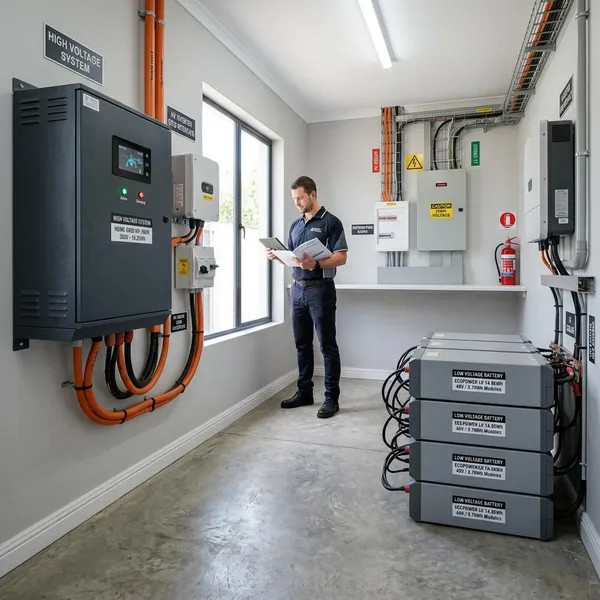
What Are the Pros and Cons of Each Battery Type?
High-voltage systems usually win on efficient power delivery and neat integration. Low-voltage systems often win on modularity, familiarity, and staged expansion. The better option depends on whether your home is trying to cover high-power loads or simply store solar energy and keep essentials running.
High-voltage batteries offer efficient power delivery
The main benefit is lower current for the same power output. In a larger installation, that may mean smaller conductors, lower losses, and better pairing with a high-output inverter.
This becomes more useful in homes with bigger loads: air conditioning, heat pumps, well pumps, induction cooking, or a plan to support more circuits during an outage. For a small home that only wants evening solar use, the efficiency advantage may not justify a more locked-in system.
High-voltage batteries need compatible equipment
A high-voltage battery must match the inverter's voltage range, communication method, firmware, and approved system design. Some products work best inside one manufacturer's ecosystem, which can be convenient but less flexible later.
Before choosing one, confirm whether replacement batteries, added modules, monitoring, and warranty support remain available if you change the inverter or expand the system in a few years.
How to Choose the Right Battery for Your Home?
Start with the job you want the battery to do. A battery for daily solar self-consumption is not the same as a battery for multi-hour outage protection. A compact system for a few critical circuits has different priorities from a full-home backup system for an all-electric house.
Match battery voltage with your power needs
For modest loads, a low-voltage system can be enough and may be easier to expand in small steps. For higher output needs, high-voltage storage often deserves a closer look because it can support stronger power delivery with less current.
Picture two homes. One wants to run lights, internet, a fridge, and a few outlets during an outage; a modular low-voltage battery may be perfectly reasonable. The other has a heat pump, well pump, EV plans, and a desire to keep much of the house running; that home should usually compare high-voltage integrated options early.
Check inverter compatibility before buying
This is the check to make before price shopping too seriously. A battery that is not officially compatible with the inverter may lose monitoring features, backup functions, warranty support, or safe charge and discharge control.
- Ask for the approved battery list for the exact inverter model.
- Confirm communication support, not just matching voltage.
- Check backup behavior: which circuits run, for how long, and at what power limit.
- Ask about firmware requirements before installation day.
- Get expansion limits in writing, including module count and model-matching rules.
Compare cost, expansion, and long-term value
The cheapest battery is not always the lowest-cost system over time. A low upfront price can become expensive if expansion is limited, service is difficult, or the inverter has to be replaced earlier than expected.
A better comparison is lifetime usefulness: does the system cover your real backup goals, can it grow with your household, and is there credible local support for the equipment? Monitoring and installer support are not exciting on a brochure, but they matter when something fails during an outage.
Choose a system that fits future energy plans
If you may add more solar panels, buy an EV, switch to electric heating, or move from essential backup to broader backup, choose a platform with room to grow. That does not mean oversizing everything today. It means avoiding a system that reaches its limit as soon as your energy use changes.
A practical compromise is to size the first installation for your current daily use, then confirm the exact path for adding modules later. If there is no clear upgrade path, treat that as a real cost, even if the quote looks attractive.
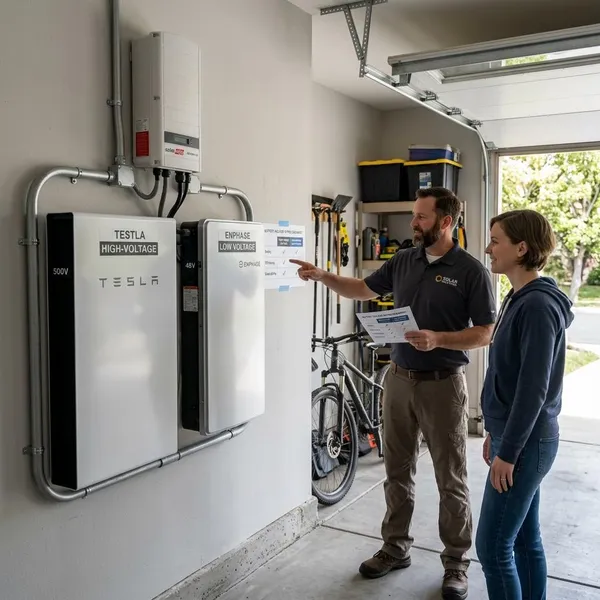
Common Battery Voltage Myths to Avoid
Battery voltage is easy to turn into a sales shortcut. Higher voltage can sound more advanced. Lower voltage can sound safer. Neither claim is useful unless it is tied to the actual inverter, wiring, loads, installation, and expansion plan.
Higher voltage does not always mean better performance
A high-voltage battery can reduce current and improve efficiency in the right design, but it does not automatically give you more stored energy, longer backup time, or better outage performance.
If the inverter is undersized, the backed-up circuits are poorly chosen, or the battery cannot communicate properly with the system, the voltage advantage will not rescue the installation.
Lower voltage does not always mean safer operation
Lower voltage may reduce some risks, but high current brings its own problems. Loose terminals, undersized cables, weak overcurrent protection, or poor heat management can make a low-voltage system unsafe.
A safer question is: how does the system detect faults, isolate problems, and stop charging or discharging when something goes wrong?
Battery choice depends on the complete system
The right battery is the one that works cleanly with the inverter, solar array, backup panel, controls, and future expansion plan. Two systems with the same voltage class can perform very differently once installed.
When a quote looks appealing, test it against your real use case: daily solar shifting, essential backup, whole-home backup, or future electrification. That usually reveals the better choice faster than comparing voltage labels.
Conclusion
Choose high voltage when your home needs stronger integrated power delivery and the inverter-battery platform is clearly approved; choose low voltage when modular growth, essential backup, or retrofit flexibility matters more. The smartest decision is to define your loads, confirm compatibility, and check the expansion path before comparing prices. A battery that fits your actual home will beat a technically impressive system that is awkward to live with.