
If you are asking which way should a solar panel face, start with the equator: south in the Northern Hemisphere and north in the Southern Hemisphere. That usually gives the highest yearly production, but it is not the only smart choice. Shade, roof shape, time-of-use electricity rates, and when you use power can make an east, west, or split layout more practical.
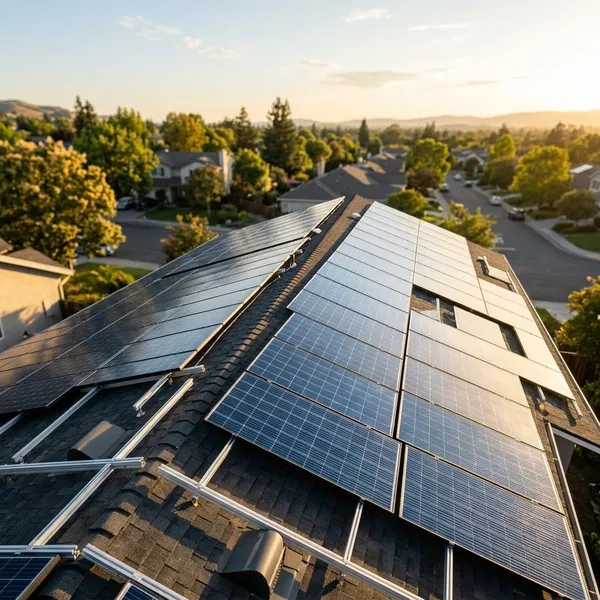
Best Solar Panel Direction by Location
The simple rule is useful: aim fixed panels toward the equator first, then adjust your decision for the actual roof and shading. A perfect compass direction on a shaded roof is usually worse than a slightly less ideal direction with clear sun.
| Where you are | Usual best fixed direction | What to check before deciding |
|---|---|---|
| Northern Hemisphere | True south | Afternoon shade, roof pitch, and utility rates |
| Southern Hemisphere | True north | Morning or evening loads, trees, and roof space |
| Near the equator | Less direction-sensitive | Tilt, seasonal sun path, and local cloud patterns |
Northern Hemisphere
In the Northern Hemisphere, including most of the United States and Europe, fixed solar panels usually perform best facing true south. That direction catches strong sun through the middle of the day and tends to produce the most energy over a full year.
Do not reject an east- or west-facing roof too quickly, though. For a household that uses little electricity at noon but runs air conditioning, cooking appliances, or EV charging later in the day, a west-facing section may have better bill value than its annual output number suggests.
Southern Hemisphere
In the Southern Hemisphere, the usual target is true north because the sun's main path is across the northern sky. This applies to places such as Australia, South Africa, and much of southern South America.
If the north-facing roof is broken up by vents, dormers, or shade, compare it with cleaner east and west roof faces. A slightly lower-output layout with fewer obstructions can be easier to install and more reliable than forcing panels onto a cramped "ideal" face.
Locations near the equator
Near the equator, direction is often less critical because the sun can pass high overhead and shift seasonally. Small differences in compass direction may matter less than whether the panels avoid shade and have a sensible tilt for rain, cleaning, and local sun patterns.
How Panel Direction Changes Daily Output
Direction changes more than the yearly total. It also changes the hour when your panels make the most power, which matters if your utility charges different rates during the day or if you want to use more of your own solar power directly.
Panels facing the equator
Equator-facing panels give the most balanced "default" result for many fixed systems. In the U.S., south-facing panels usually peak around solar noon and are the right first option when the goal is maximum annual production.
- Best fit: homes with steady daytime use or simple net metering.
- Main weakness: less help during early morning or late afternoon peaks.
- Check first: whether midday shade cuts into the strongest production window.
East-facing panels
East-facing panels wake up earlier. They are useful when a home has meaningful morning demand, such as breakfast cooking, heat pump use before work, or charging small devices and batteries early in the day.
For a portable or cabin setup used mainly in the morning, east-facing placement can feel more useful than a direction that produces more total energy later when nobody needs it.
West-facing panels
West-facing panels shift more production into the afternoon and early evening. They can be a good match for homes that run cooling loads after work or pay higher late-day electricity rates.
The trade-off is that west-facing panels often produce less annual energy than an ideal equator-facing array. That is not automatically a problem if the power arrives when it offsets more expensive grid electricity.
Combined east-west layouts
An east-west layout spreads production across more of the day instead of concentrating it around noon. It can work well when roof space is split across two faces or when a household has all-day loads rather than one clear peak.
- Morning plus afternoon coverage: useful for busy homes with people in and out all day.
- Better roof use: helpful when the best-facing roof area is too small.
- Smoother output curve: sometimes easier to match with self-consumption.
Panels facing away from the equator
Panels facing away from the equator are usually the weakest fixed option. In the U.S., that means north-facing panels often lose more production than east- or west-facing panels.
They are not always a hard no. If the only south-facing roof is shaded by trees for much of the day, a clear north-facing roof with a shallow pitch may deserve a modeled estimate before you rule it out.
How to Choose a Direction for Your Solar Panels
Choose direction in a practical order: confirm the roof faces, check shade, compare production estimates, then match the best options to your electricity use. Guessing from the street or choosing only by compass direction is where many weak solar layouts start.
Identify your roof's compass direction
Check each usable roof plane separately. Many homes look square to the road but sit at an angle, and a small assumption can change whether a roof is southeast, south, or southwest.
- Use satellite view to identify roof planes.
- Use a compass app only after checking whether it shows true or magnetic north.
- Ask an installer for the azimuth of each proposed roof face.
- Ignore tiny roof sections that cannot fit enough panels cleanly.
Check shade across the seasons
Shade should be checked before you fall in love with a direction. A roof that looks perfect at noon in June may be hit by tree shade, a chimney, or a neighboring building when the sun is lower in winter.
A simple homeowner check is to look at the roof in the morning, around midday, and late afternoon. For a long-term system, ask for a shade analysis rather than relying on a quick visual opinion, especially if trees are nearby.
Compare output estimates for each roof face
Side-by-side estimates are more useful than a general rule. Ask for expected production for each realistic roof face, not just the layout the installer prefers.
A helpful comparison should show annual output, obvious seasonal dips, and the effect of shade. If two layouts are close, choose the one with fewer obstructions, cleaner wiring, easier maintenance, or better timing for your usage.
Match generation times to your electricity use
The highest-producing direction is not always the highest-value direction. A household with someone working from home may benefit from midday production, while a home that is empty all day but uses power heavily after 4 p.m. may get more practical value from west-facing panels.
- Morning-heavy use: consider east-facing panels.
- Midday use: equator-facing panels usually make sense.
- Late-day cooling or cooking: compare west-facing output carefully.
- Mixed all-day use: an east-west split may be easier to use directly.
Compare roof and ground-mount options
If the roof is awkward, shaded, or facing the wrong way, a ground mount can give you more control over direction and tilt. It is especially worth comparing when you have open land and plan to keep the system long term.
The downside is extra cost, space, permitting, and site work. For a small roof system, accepting a decent east or west roof may be simpler; for a larger property with poor roof exposure, a ground mount can be the cleaner decision.
Conclusion
For most fixed systems, aim panels toward the equator unless shade, roof limits, or your electricity-use pattern gives you a better reason not to. The best decision is not "south at any cost" or "use every roof face"; it is the layout that gives clear sun, reasonable production, and power at the hours when it actually helps you.