
A home battery backup with transfer switch lets you keep essential circuits running during a power outage without unsafe cords, backfeeding risks, or manual rewiring. The key is matching the battery and transfer switch to the loads you actually need—such as a refrigerator, Wi-Fi router, lights, sump pump, or medical device—while making sure the system is properly rated, code-compliant, and installed to connect safely with your electrical panel.
How does a home battery backup system work?
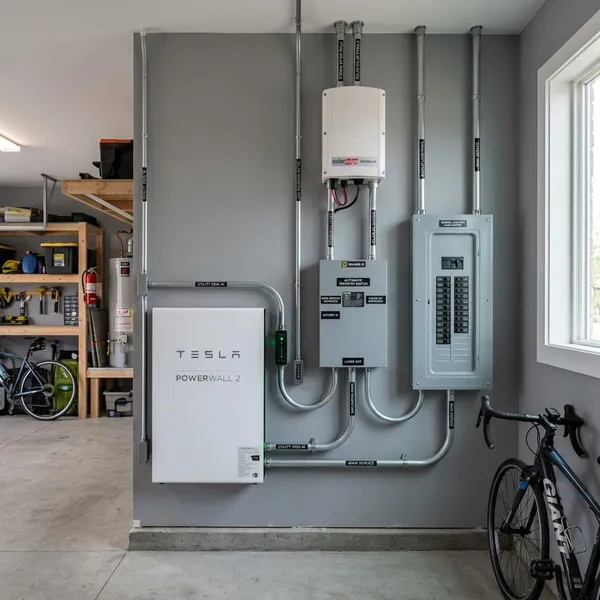
A home battery backup system stores electricity and sends it through an inverter when utility power is not available. If the system is connected to home wiring, a transfer switch or approved backup interface separates your house from the grid before backup power reaches selected circuits.
The basic flow is simple: the battery charges when power is available, the inverter turns stored energy into household AC power, and the transfer equipment decides whether the home is being supplied by the grid or by the backup system. In many permanent systems this happens automatically, while some smaller or simpler setups require manual switching.
Batteries store energy for future power needs
The battery is the stored fuel for the system, usually described in kilowatt-hours. More usable battery capacity generally means longer backup time, but runtime changes quickly depending on what is connected. A refrigerator, Wi-Fi router, a few lights, and phone charging may be manageable for many hours, while electric heat, an oven, or central air conditioning can drain the same battery much faster.
- Check usable capacity: the advertised size may not be the full amount available during backup.
- Look at reserve settings: some systems hold energy back for battery protection or emergency use.
- Think in outage habits: overnight essentials need a different battery than all-day comfort loads.
Inverters convert stored energy into usable electricity
The inverter changes battery power into the type of electricity household circuits use. Its continuous output rating tells you what it can run steadily, while its surge rating matters when motors or compressors start.
This is where a system can disappoint even if the battery looks large enough. A well pump, sump pump, freezer, or air conditioner may have a short startup surge that is much higher than its normal running load. If those appliances matter to you, ask for the inverter's surge capability to be checked against the actual equipment, not just estimated from a generic appliance chart.
Transfer switches control power between the grid and backup system
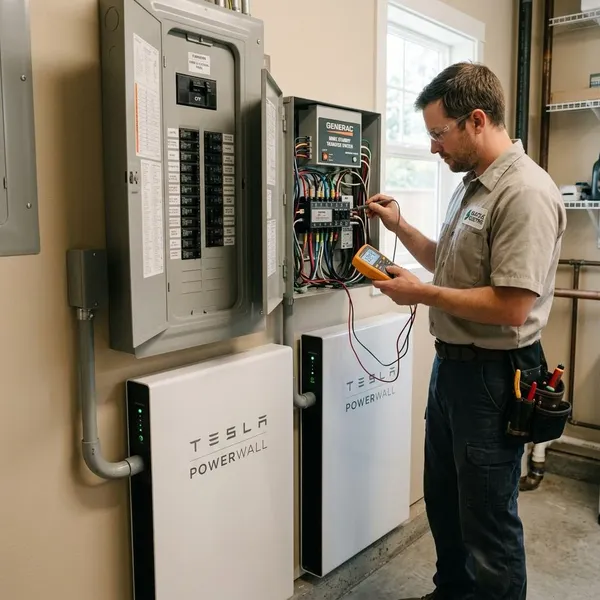
The transfer switch controls whether selected home circuits receive grid power or backup power. In a critical-loads design, it may feed a smaller subpanel with only essentials. In a broader setup, it may work with a backup gateway, main panel, or load management controls. The key point is that it prevents the battery system and the utility supply from feeding the same wiring at the same time.
Why do you need a transfer switch for battery backup?
You need a transfer switch when a battery backup is meant to feed home circuits through your electrical panel. Plugging a portable battery directly into appliances is one thing; connecting backup power to household wiring is different because the system must be isolated from the utility grid.
The transfer switch also turns a battery from a "power source" into a usable home backup plan. It decides which circuits stay live, helps avoid overload, and reduces the temptation to use unsafe workarounds during a stressful outage.
Transfer switches prevent unsafe power backfeed
Backfeed happens when backup power flows out toward utility lines or into parts of the electrical system that should not be energized. That can endanger utility workers, damage equipment, and create serious safety problems when grid power returns. A proper transfer switch prevents this by disconnecting the home from the grid before backup power is supplied.
Transfer switches control which circuits receive backup power
This is the practical reason many homeowners should start with a circuit list rather than a battery brand. If your outages are usually short and you only care about food, lights, internet, and basic charging, a critical-loads setup may be enough. If you work from home, rely on a sump pump, or need a medical device powered, those circuits should move higher on the backup priority list.
| Backup priority | Typical circuits to consider | Why it matters |
|---|---|---|
| Must-have | Refrigerator, freezer, medical equipment, sump pump, internet | Protects health, food, communication, or property |
| Useful | LED lighting, garage door, select outlets, security system | Makes an outage easier without using much energy |
| High-demand | HVAC, well pump, water heater, cooking appliances | May require larger inverter output, surge capacity, and more battery storage |
What can a home battery backup with a transfer switch run?
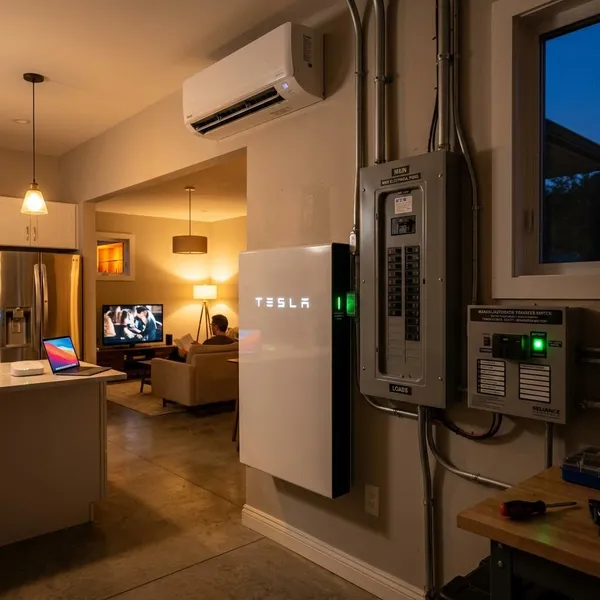
A battery backup can run selected circuits or, with a larger design, much of a home. The limit is not only battery size. You also need enough inverter output for the loads that may run at the same time and enough surge capacity for appliances that start with a power spike.
For most homes, the best value is not "power everything." It is "power the things that would cause real trouble if they went off." That might be food storage and internet in one house, a sump pump in another, or a well pump in a rural home.
Small systems support essential devices and circuits
Small systems are best for short outages or low-demand backup. They often cover a refrigerator, freezer, modem and router, LED lights, phone charging, security equipment, and a few outlets. This is a sensible setup if your neighborhood loses power for a few hours at a time and you mainly want to avoid spoiled food and lost communication.
The mistake is adding "just one more" load until the system is no longer predictable. A small battery that works well for essentials may struggle if someone plugs in a space heater or uses a high-wattage kitchen appliance during backup mode.
Larger systems support appliances and higher loads
Larger systems can support more demanding appliances, but the design has to match the real load. Pumps, compressors, microwaves, laundry equipment, and some HVAC equipment may be possible, yet they should be checked for both running watts and startup surge.
- Well pump: confirm voltage, horsepower, and startup surge before assuming it can run.
- Sump pump: treat it as a priority load if basement flooding is a risk.
- Air conditioning: ask whether soft-start equipment or load controls are needed.
- Electric heating: usually demands much more battery capacity than basic essentials.
Whole-home systems require more capacity planning
Whole-home backup is possible, but it is usually a bigger project than simply adding more batteries. It may require multiple battery modules, a high-output inverter, smart load controls, panel work, and a clear plan for large appliances.
A summer outage in a hot climate is a good example. If air conditioning is non-negotiable, the system needs to be planned around that load from the beginning. In a milder climate where refrigeration, lights, and internet are the real priorities, spending heavily to support full HVAC may not be the best use of the budget.
How do you size a home battery backup system?
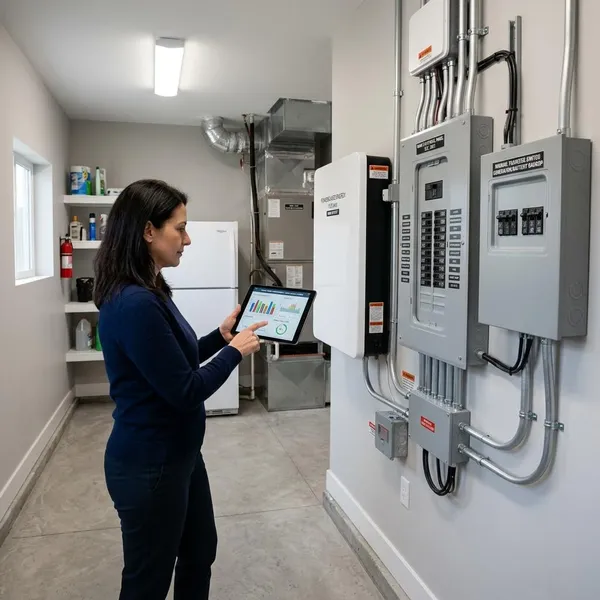
Size the system by separating two questions: how much power your loads need at one moment, and how much energy they use over time. Power is measured in watts or kilowatts. Energy is measured in watt-hours or kilowatt-hours.
A practical sizing process starts with essentials, not wish lists. Decide what must stay on, estimate how long it should run, then add optional loads only if the budget and equipment can support them safely.
Calculate running watts and startup power needs
Make a list of every circuit or appliance you want backed up, then find the running wattage and any startup surge. Nameplates, manuals, installer measurements, or manufacturer data are better than guessing. Pay special attention to refrigerators, freezers, pumps, and HVAC equipment because their startup demand can be the deciding factor.
- List essentials first: food storage, communication, medical needs, pumps, and key lighting.
- Add running watts: estimate what may operate at the same time.
- Check surge loads: identify motors and compressors that need extra starting power.
- Remove weak priorities: avoid spending heavily to support loads you would rarely use in an outage.
Match battery capacity with backup time goals
Once you know the likely load, match it to the backup time you want. A simple starting point is average backup load multiplied by hours of runtime. For example, an average 1 kW essential load for 10 hours points to about 10 kWh of usable battery capacity before adding a safety margin.
Real homes are less tidy than the formula. Refrigerators cycle, people turn on extra lights, pumps may run more during storms, and some battery capacity may be reserved by the system. If outages in your area often last overnight, size for the night you actually expect, not the perfect low-use scenario.
What should you know about installation and safety?
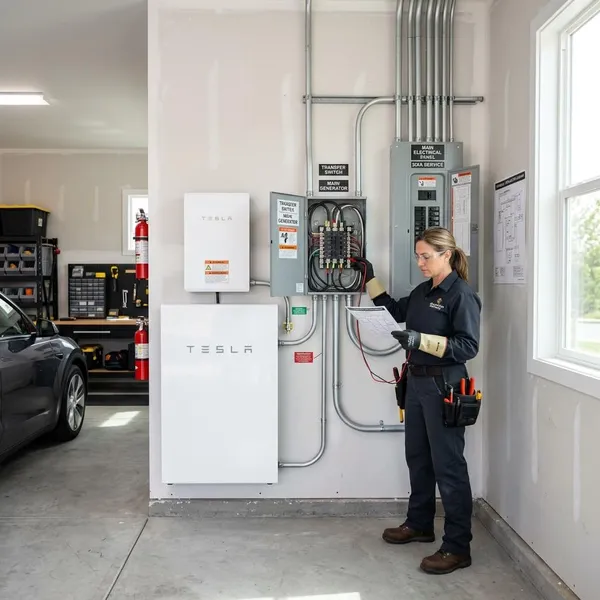
Installation is where battery backup moves from shopping decision to electrical safety decision. A fixed system may involve panel wiring, transfer equipment, disconnects, grounding, labeling, permits, inspections, and sometimes utility coordination.
Before buying equipment, ask three practical questions: Can the panel support this design? Which circuits will be backed up? Are the battery, inverter, and transfer equipment approved to work together? Those answers can affect cost as much as battery size.
Electrical work may require permits and inspections
Permits are commonly required for permanent battery backup and transfer switch installations, though the exact rules depend on the location. An inspection may feel like a delay, but it can catch unsafe wiring, missing labels, incorrect disconnects, or grounding problems before the system is relied on during an outage.
Professional installation improves system safety
A licensed electrician or qualified energy storage installer can check conductor sizing, breaker coordination, panel capacity, equipment clearances, and correct transfer operation. That is difficult to verify safely as a homeowner, especially when the system interacts with utility power.
Professional help is especially important for higher-risk situations: homes with medical equipment, sump pumps, well pumps, frequent outages, or owners who travel often. In those cases, automatic switching and proper testing may matter more than saving money on a simpler manual setup.
Conclusion
The smartest battery backup setup is the one sized around your real outage priorities, not the one with the most impressive headline capacity. Start with the circuits you cannot afford to lose, check surge and runtime needs, and use approved transfer equipment so backup power reaches the house safely. For many homes, a focused critical-loads system is enough; for pumps, air conditioning, or whole-home comfort, plan for a larger and more carefully managed design.