
A portable power station works like a rechargeable battery with a few extra parts built in: it accepts electricity from a charger, stores that energy, then sends it back out through the right port for your device. The first things to check are battery capacity, output wattage, and whether your device needs AC power, USB-C, or 12V DC. If those three do not match your use case, even a large-looking unit may disappoint you.
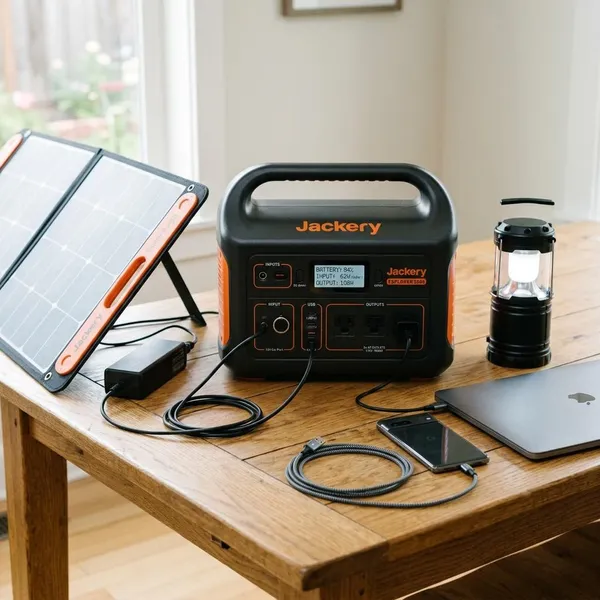
How does a portable power station work step by step?
The basic flow is simple, but each stage affects what the station can safely run. A phone charger, a laptop, and a refrigerator do not ask the unit for power in the same way, so it helps to know where the limits come from.
Power enters from a charging source
Electricity first comes in from a wall outlet, car outlet, or solar panel. The station does not send that power straight into the battery untouched; internal charging electronics regulate the input so the battery receives power in a controlled way.
For everyday use, this matters because the charging source sets expectations. A wall outlet may refill a unit before a weekend trip, while a car outlet is usually better for topping up during a drive than for fully recharging a large battery from empty.
The battery stores the energy
The battery is the storage tank. Its capacity is usually shown in watt-hours, and that number tells you roughly how much energy is available before conversion losses and safety reserves are considered.
- Small capacity: good for phones, tablets, lights, and short laptop use.
- Medium capacity: better for routers, fans, CPAP machines, and compact fridges.
- Large capacity: useful when appliance runtime matters more than easy carrying.
The inverter converts power when needed
The battery stores DC power, but household outlets supply AC power. When you plug something into an AC outlet on the station, the inverter converts DC into AC so the device can use it.
The important limit here is not just battery size. A station may have plenty of stored energy but still fail to run a device if the inverter cannot handle the device's running watts or short startup surge. This is a common mistake with refrigerators, pumps, power tools, and kitchen appliances.
The output ports power connected devices
Once power is ready, it leaves through the port you choose. Use AC outlets for household plugs, USB-C for many modern laptops and phones, USB-A for smaller accessories, and 12V DC for certain travel devices.
A practical rule: use the lowest-conversion option that fits your device. Charging a phone through USB is usually more sensible than using an AC wall adapter plugged into the station, because each conversion can waste some energy.
The system monitors battery and load
Built-in controls track temperature, battery level, charging status, and output load. If the station is overloaded or gets too hot, it may shut off or reduce output to protect itself.
The display is not just decoration. Watch the live watt draw when you plug in a device; it quickly tells you whether your planned setup is realistic or whether one appliance is draining the battery faster than expected.
How does a portable power station charge?
Charging is where planning makes the biggest difference. Before relying on a station for camping or outage backup, check not only how much energy it stores but also how quickly you can put energy back in.
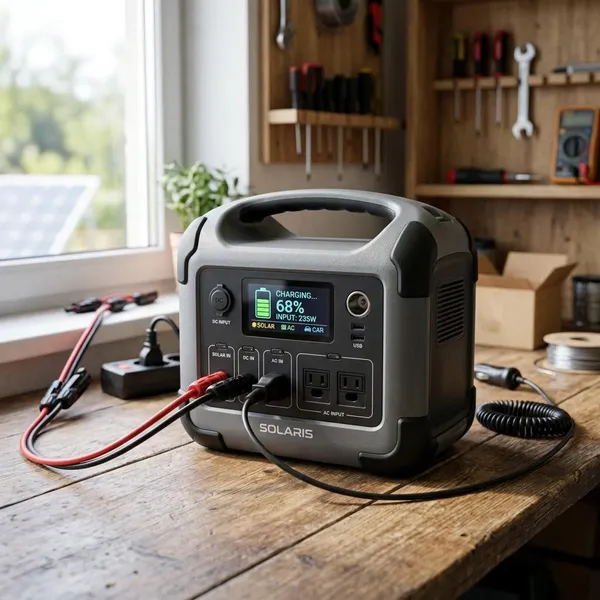
Wall outlets provide AC charging
A wall outlet is usually the easiest way to prepare the unit at home. Plug it in before a trip, storm warning, or planned outdoor day, and the station's charger manages the battery refill.
This is the best default for low-stress situations: charging phones during an outage, running a router for a while, or taking power to a campsite already topped up. The main check is charging time, because a large unit may still need several hours depending on the model's input limit.
Car outlets provide mobile charging
Car charging is useful but limited. It is better for maintaining charge during travel than for rescuing a large empty station at the last minute.
For a road trip, this can work well if you drive during the day and only use light loads at night. For long-term off-grid use, relying only on a car outlet usually becomes frustrating unless your power needs are very small.
Solar panels provide off-grid charging
Solar charging can keep a station useful away from the grid, but it is the least predictable charging method. Panel size, shade, clouds, sun angle, cable setup, and the station's solar input limit all affect the result.
- Good fit: summer camping, RV stops, garden work, or emergency top-ups in daylight.
- Weak fit: heavy daily appliance use with small panels or poor sun exposure.
- Must check: panel voltage range and connector compatibility before buying.
What affects portable power station runtime?
Runtime is not a fixed number printed on the box. It changes with the battery size, the device you connect, the type of output used, and the conditions around the battery.
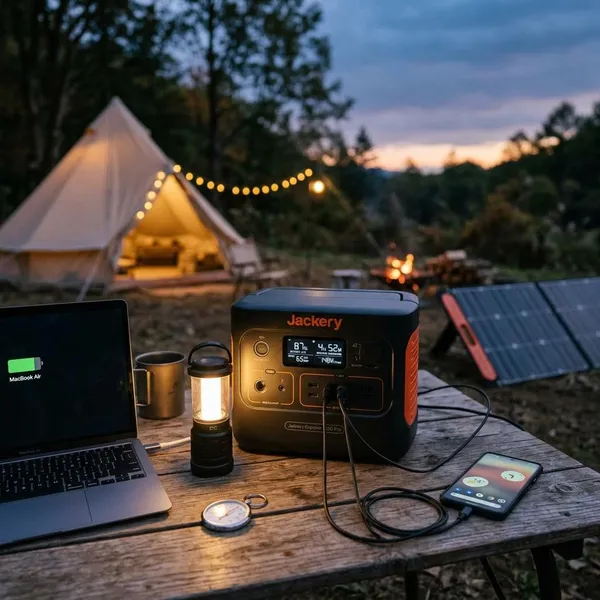
Battery capacity affects runtime
Battery capacity gives you the starting point. A 1,000Wh station should usually run the same device much longer than a 300Wh station, assuming both can support the device's wattage.
A simple estimate is: battery watt-hours divided by device watts. Treat that as a rough ceiling, not a promise, because conversion losses and battery protection reduce the usable amount.
Device wattage affects runtime
The device is often the real deciding factor. A laptop or fan may be easy to support, while a heater, microwave, kettle, or coffee maker can drain a station very quickly.
| Device type | What to check first | Practical expectation |
|---|---|---|
| Phone, tablet, camera | USB output and total capacity | Usually easy for even small units |
| Laptop or router | USB-C wattage or AC draw | Often manageable with a small or mid-size unit |
| Fridge or power tool | Startup surge and inverter rating | Needs more careful matching |
| Heater or cooking appliance | Continuous wattage | Often drains batteries fast |
Inverter losses reduce usable energy
Using AC power costs some energy because the inverter has to convert battery DC into household-style AC. That lost energy usually turns into heat, so the full advertised battery capacity is not available at the outlet.
If you are only charging small electronics, direct USB-C or 12V DC output can be more efficient than plugging in an AC adapter. For short backup use this may not matter much, but on a multi-day camping setup it can noticeably stretch the battery.
Temperature affects battery performance
Cold weather can reduce usable performance, and high heat can stress the battery or trigger protection limits. The exact limits vary by model, so the safer habit is to store and charge the unit in moderate conditions whenever possible.
This is especially important for year-round emergency storage. Keeping the station in a very hot vehicle, damp shed, or freezing garage may be convenient, but it is not ideal if you expect reliable backup power later.
What can a portable power station run?
A portable power station can run devices that fit within three limits: battery capacity, continuous output, and surge output. Start with the device you care about most, not with the biggest station you can find.
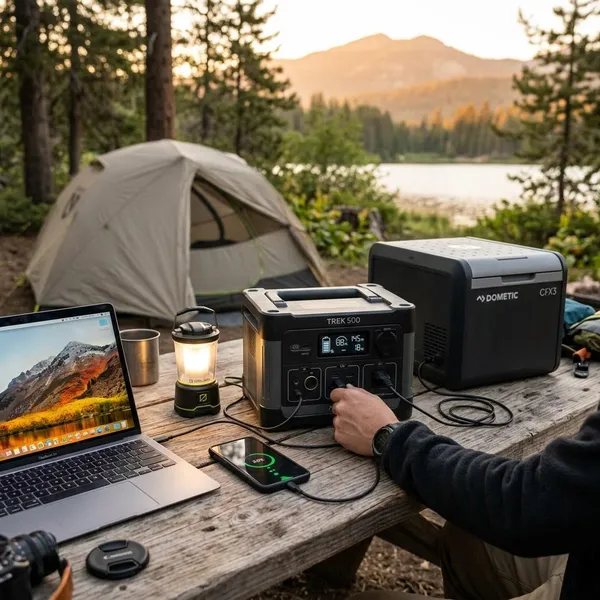
Small units power phones and laptops
Small units make the most sense for personal electronics: phones, tablets, cameras, drones, LED lights, and many laptops. They are easy to carry and usually enough for a day trip, a short outage, or working away from an outlet for a few hours.
They are not a good choice if your real goal is running appliances. If a product photo shows a tiny station next to a refrigerator or coffee maker, check the wattage carefully before trusting that setup.
Mid-size units power essential devices
Mid-size stations are often the practical middle ground for home and outdoor use. They can support devices such as routers, fans, monitors, CPAP machines, portable fridges, and small appliances for limited periods, depending on the exact draw.
For a typical outage plan, this category is worth considering if you want to keep communication, basic comfort, or one important medical-style device running. For anything health-related, confirm the device's power requirements and test the setup before you need it.
Large units power higher-wattage appliances
Large units can handle more demanding loads, but they are not magic replacements for whole-home power. Refrigerators, microwaves, power tools, and window AC units may be possible only when the station's inverter rating, surge rating, and battery capacity all line up.
- Temporary outage: prioritize the fridge, router, lights, and phone charging.
- Camping comfort: prioritize fans, cooking support, and cooler runtime.
- Daily heavy use: look closely at recharge speed, solar input, and battery cycle life.
The safest buying approach is to list your must-run devices, find their wattage labels, note any startup surge risk, and then choose a station with enough margin instead of matching the numbers too tightly.
Conclusion
A portable power station is easiest to judge when you think of it as stored energy plus an output limit. Capacity tells you how long it may last, while the inverter and ports decide what it can actually run. If you check your most important device first and leave some margin for losses, surge demand, and temperature, you are far less likely to buy a unit that looks powerful but fails in the situation you bought it for.