
Calculating how long a solar panel takes to charge a battery comes down to a simple estimate: compare the battery energy that must be replaced with the solar panel power you can actually use during peak sun hours. In practical terms, you convert the battery capacity to watt-hours, divide it by the panel's real charging output, and allow for efficiency losses from the charge controller, wiring, temperature, and battery charging behavior. This gives a realistic charging-time estimate for RV batteries, boats, sheds, off-grid systems, and emergency backup setups.
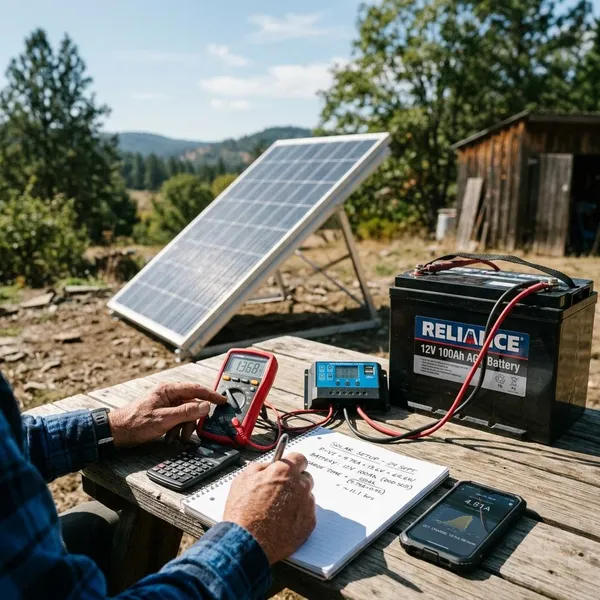
How to Calculate Solar Panel Charging Time
The most practical method is to work in watt-hours, not amp-hours alone. Watt-hours let you compare the battery's stored energy with the solar panel's power output using the same unit.
Charging time in hours = Energy to replace ÷ (Panel watts × Efficiency)
For daily planning, include peak sun hours:
Charging time in days = Energy to replace ÷ (Panel watts × Peak sun hours × Efficiency)
Use battery watt-hours to measure stored energy
Battery watt-hours show how much energy the battery can store. If the battery label only gives amp-hours, convert it first:
Battery watt-hours = Battery volts × Battery amp-hours
A 12V 100Ah battery stores about 1,200Wh. If it is only half discharged, you do not need to replace the full 1,200Wh; you need roughly 600Wh, plus charging losses. That one detail prevents many charging estimates from looking much worse than reality.
Use solar panel watts to estimate charging power
Panel watts give the starting point for charging speed. A 100W panel charging a 1,200Wh battery gives this ideal result:
1,200Wh ÷ 100W = 12 effective charging hours
That is not 12 normal daylight hours. It means 12 hours at full rated output, which a panel rarely produces outdoors. If you use two 100W panels, the ideal estimate becomes 1,200Wh ÷ 200W = 6 effective charging hours before losses.
Add system losses for a more accurate result
Real systems lose energy through heat, wiring, the charge controller, panel angle, and the battery's own charging behavior. For many small setups, using 70% to 85% efficiency is a sensible planning range; 80% is a practical middle estimate.
- 100W panel at 80% efficiency: about 80W of usable charging power.
- 1,200Wh battery from empty: 1,200 ÷ 80 = about 15 effective solar hours.
- With 5 peak sun hours per day: about 3 good solar days.
For a weekend RV battery that is only partly used, this may be acceptable. For a battery that must recover fully every day, one 100W panel is usually too small.
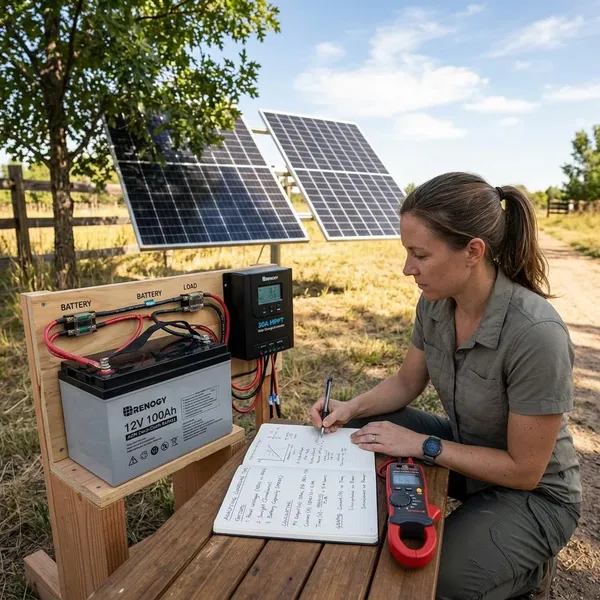
What Affects Solar Battery Charging Time?
The formula gives the estimate, but the setup decides how close that estimate feels in real use. The first things to check are sunlight, total panel watts, battery type, and hidden losses such as shade or poor wiring.
More sunlight increases daily charging power
Peak sun hours matter more than total daylight hours. A 100W panel in 5 peak sun hours can make about 500Wh before losses, or around 400Wh if you assume 80% system efficiency.
This is why a setup that works in July may disappoint in winter. A summer-only cabin light system can tolerate slower charging, but a year-round backup battery needs more margin for short days, low sun angle, and cloudy weather.
Larger panels increase charging speed
More panel wattage shortens the effective charging time because more energy is available while the sun is strong.
| Total solar watts | Usable power at 80% | Approx. time for 1,200Wh | Best fit |
|---|---|---|---|
| 100W | 80W | 15 effective hours | Maintenance or light use |
| 200W | 160W | 7.5 effective hours | Weekend RV or modest daily use |
| 300W | 240W | 5 effective hours | Better chance of same-day recovery |
Battery type changes charging performance
Battery chemistry affects how quickly stored energy can be replaced. Lithium iron phosphate batteries often accept charge efficiently through much of the cycle, while lead-acid batteries usually slow down more noticeably near full charge.
For occasional topping up, the difference may not matter much. For daily cycling, especially with limited sun hours, lithium often feels faster because it makes better use of the available solar window.
Weather and system losses reduce charging output
Clouds, shade, heat, dust, poor panel angle, thin cables, and controller losses can all reduce charging speed. Partial shade is especially easy to underestimate; a small shadow from a roof vent, railing, branch, or antenna can cut output sharply.
- Check shade first: look at the panel during the strongest sun hours, not only in the morning.
- Check panel position: a flat panel may underperform when the sun is low.
- Check wiring: long or undersized cables waste power every day.
- Check dirt and heat: dusty or very hot panels usually produce less than their rating.
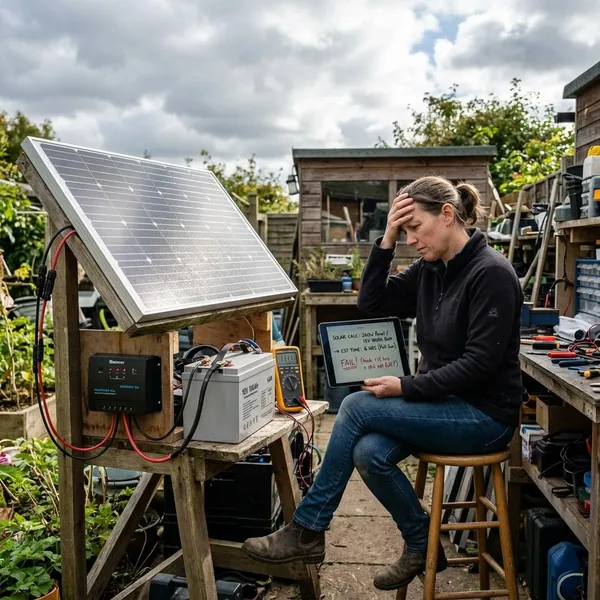
Why Solar Charging Estimates Are Often Inaccurate
Solar charging estimates usually fail because the inputs are too optimistic. The panel rating is treated as constant output, the battery label is treated as the exact charging need, and the slow final charging stage is ignored.
Rated panel watts are not real-time output
A 100W panel is rated under standard test conditions, not under changing outdoor conditions. Morning sun, late afternoon sun, heat, clouds, and poor angle all reduce output. That is why peak sun hours are more useful than counting every hour between sunrise and sunset.
Battery capacity is not the same as charging needs
The battery label shows total capacity, but charging time depends on the energy you actually used. A 12V 100Ah battery may store about 1,200Wh, yet a 50% discharge only needs roughly 600Wh replaced before losses.
This matters when comparing light use with heavy use. Running a few LED lights overnight is very different from powering a fridge, inverter, or pump. The battery may be the same size, but the daily recharge target is not.
Charging slows near full battery levels
The last part of charging can take longer than the simple formula suggests. Lead-acid batteries often enter a slower absorption stage near full charge, while lithium batteries usually stay in the faster part of the cycle longer but still taper near the top.
If your goal is "mostly recharged by afternoon," the estimate may be close enough. If your goal is "fully charged every day," add more margin because the final 10% to 20% can be the slowest part.
Efficiency losses reduce usable power
A realistic efficiency factor keeps the estimate from being too optimistic. Use the lower end when the system has shade, heat, long cables, a basic controller, or uncertain conditions.
- 0.70 to 0.75: conservative estimate for mixed or imperfect setups.
- 0.80: useful default for many small consumer systems.
- 0.85: possible for a well-set-up system in good conditions.
How to Choose the Right Solar Panel Size
The right panel size is not just the panel that can eventually charge the battery. It is the panel size that can replace your normal energy use within the time you actually have sunlight.
Match panel watts with battery capacity
Start by checking whether the panel size makes sense for the battery. A 12V 100Ah battery stores about 1,200Wh. To recharge that battery from empty in one good day with 5 peak sun hours and 80% efficiency, the rough solar target is:
1,200Wh ÷ (5 × 0.8) = 300W
So a single 100W panel can charge that battery, but it is not a good choice if you expect a full same-day recharge. It is better for maintenance charging, light weekend use, or situations where slow recovery is acceptable.
Size panels for your daily charging goal
A more useful sizing method is to calculate the energy you need to replace each day:
Required solar watts = Daily energy needed ÷ (Peak sun hours × Efficiency)
If you use 600Wh per day and get 5 peak sun hours with 80% efficiency, the minimum target is:
600 ÷ (5 × 0.8) = 150W
In that case, choosing 200W instead of exactly 150W is usually more comfortable. The extra panel capacity gives you room for cloudy afternoons, imperfect angle, and slightly heavier use.
Add extra capacity for changing conditions
Adding 20% to 50% more solar than the bare minimum is often the difference between a system that works on paper and one that feels reliable. The lower end may be enough for summer camping; the higher end is more sensible for winter use, cloudy regions, or batteries that support important loads.
- Light, temporary use: small margin may be fine.
- Daily cycling: add enough panel wattage to recover normal use by the next day.
- Backup or critical loads: avoid sizing from perfect-weather numbers only.
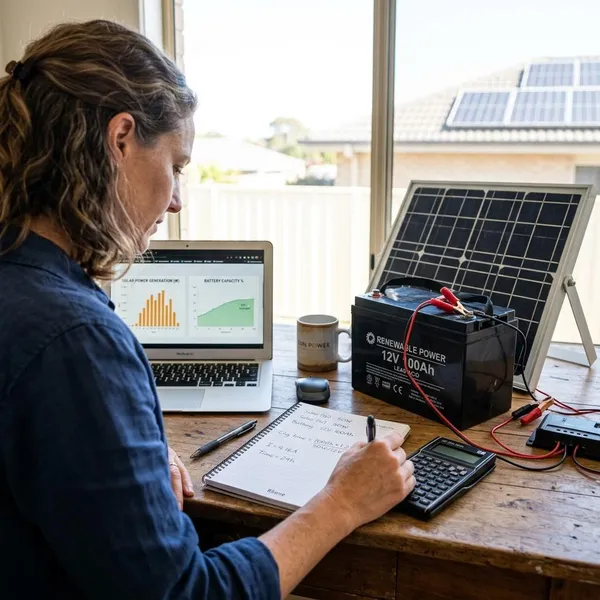
Quick Solar Charging Calculation Tips
For simple setups, a good estimate is usually more useful than a perfect calculation. Focus on getting the main inputs right before worrying about small details.
Remember the basic charging formula
Use this formula for effective charging hours:
Charging time = Battery watt-hours ÷ (Solar panel watts × Efficiency)
Use this one for solar days:
Charging days = Battery watt-hours ÷ (Panel watts × Peak sun hours × Efficiency)
If the battery is listed in amp-hours, convert it first with Watt-hours = Volts × Amp-hours.
Check battery and panel numbers first
Before calculating, confirm four things: battery voltage, battery amp-hours or watt-hours, current state of charge, and total solar panel watts. A 24V 100Ah battery stores twice as much energy as a 12V 100Ah battery, so skipping voltage can completely distort the result.
Use estimates for simple setups
For an RV accessory battery, small boat battery, shed battery, or portable backup system, use a practical estimate and round up if slow charging would be annoying. Do not use perfect-condition numbers when deciding what to buy.
- First check: how many watt-hours you actually need to replace.
- Second check: whether the panel can replace that energy in your peak sun hours.
- Common mistake: assuming a 100W panel gives 100W all day.
- When to be cautious: winter use, shaded sites, long cable runs, or important backup loads.
Conclusion
The best solar charging estimate starts with the energy you need to replace, not just the battery label. Convert the battery to watt-hours, reduce the panel rating with a realistic efficiency factor, and then compare the result with your peak sun hours. If the battery must be ready again the next day, choose more panel wattage than the minimum calculation suggests; if it is only for light or occasional use, a slower setup may be perfectly acceptable.