
Calculating solar panel needs for a home starts with your annual electricity usage, then factors in your local sunlight, roof conditions, and normal system losses. Once you know the required solar system size in kilowatts, you can estimate the number of panels by dividing that size by the wattage of each panel.

What Determines Your Home Solar Needs?
Your solar needs are not set by house size alone. The useful starting point is how much electricity your home actually uses, how much of that use you want solar to cover, and whether your roof can physically support enough well-placed panels.
Electricity use sets the required system size
Annual electricity use is the foundation of the calculation because solar systems are usually sized around yearly production. A home using 6,000 kWh per year needs a very different system from a home using 14,000 kWh, even if both homes look similar from the street.
This is where real household habits matter. A small all-electric home with heavy air conditioning or EV charging can use more power than a larger home with gas heating and efficient appliances. That is why utility bills beat square-foot estimates almost every time.
Energy goals determine solar coverage needs
Decide whether you want partial bill reduction or close to full annual offset before you calculate. If your home uses 10,000 kWh per year and you only want solar to cover 70%, your target is about 7,000 kWh, not the full 10,000 kWh.
- Budget-first plan: Size for partial offset if you mainly want lower bills and a smaller upfront system.
- Long-term electrification plan: Include likely future loads such as an EV, heat pump, or electric water heater.
- Near-full offset plan: Check roof space early, because the math may call for more panels than your roof can fit.

What Information Do You Need Before Calculating?
You only need four main inputs for a solid first estimate: annual electricity use, local peak sun hours, panel wattage, and a realistic loss factor. These numbers are enough to tell whether you are probably looking at a small 5 kW system, a mid-size 8 kW system, or something larger.
Keep the inputs practical rather than perfect. A homeowner estimate should help you understand the scale of the project and question installer quotes, not replace a site-specific design.
Annual electricity use shows energy demand
Find your total kWh use from the last 12 months of utility bills, or download yearly usage from your utility account if that option is available. Do not use one month and multiply by 12 unless you have no other choice, because summer cooling, winter heating, travel, and seasonal routines can distort the result.
Peak sun hours show solar production potential
Peak sun hours describe the average daily amount of strong, usable sunlight in your area. A location with 5 peak sun hours can produce more electricity from the same system than a location with 3.5 peak sun hours, so local sunlight directly changes the system size you need.
For a first estimate, use an annual average from a reputable solar map, local installer tool, or regional solar resource. A professional design can later adjust that number for your exact roof angle, direction, and shade.
System losses show real-world performance
Solar panels do not produce their rated output all day in real conditions. Heat, inverter conversion, wiring, dust, mismatch, and minor shading all reduce actual production.
- Use 0.8 as a practical starting point for a simple homeowner estimate.
- Use a slightly lower factor if the roof has heat, shade, or less ideal conditions.
- Use a slightly higher factor cautiously only if conditions and equipment are expected to be strong.
How to Calculate Your Solar Panel Needs Step by Step
The calculation works best when you move in order: demand first, sunlight second, losses third, system size fourth, panel count last. Skipping straight to "how many panels" usually leads to a weak estimate.
Find your yearly electricity usage
Add the kWh from your last 12 electric bills. If your goal is full annual offset, that total becomes your solar production target. If you want partial offset, multiply the yearly total by your target percentage.
Estimate your local peak sun hours
Use average daily peak sun hours for your location, then multiply by 365 for the annual sunlight value used in the formula. If your area averages 4.5 peak sun hours per day, that equals about 1,642.5 peak sun hours per year.
Adjust for system losses
Apply a derate factor so the estimate reflects real rooftop performance instead of perfect test conditions. A simple 0.8 factor means you are assuming the system delivers about 80% of the theoretical output after normal losses.
This is not pessimistic; it is useful. A calculation without losses often looks cleaner but can leave the system undersized.
Calculate the required solar system size
Use this formula:
System size (kW) = Annual electricity use (kWh) / (Peak sun hours per day × 365 × Derate factor)
Example: if your home uses 10,800 kWh per year, your area gets 4.5 peak sun hours per day, and you use a 0.8 derate factor:
10,800 / (4.5 × 365 × 0.8) = about 8.2 kW
That means you would plan around an 8.2 kW solar system for full annual offset under those assumptions.
Convert system size into panel count
Multiply the system size by 1,000 to convert kilowatts to watts, then divide by panel wattage.
8.2 kW × 1,000 = 8,200 watts
8,200 / 400W = 20.5 panels
Since you cannot install half a panel, round up to 21 panels. If the roof can only fit 18 panels, you either need higher-wattage panels, a lower offset goal, another roof section, or a different system expectation.
What Does a Solar Panel Calculation Example Look Like?
A worked example helps show why two homes with the same panel count can still have different results. The system size comes from energy use and sunlight; the panel count comes after that.
Energy use determines the system size
Suppose a home uses 12,000 kWh per year, receives 5 peak sun hours per day, and uses a 0.8 derate factor. The calculation is:
12,000 / (5 × 365 × 0.8) = about 8.2 kW
If the same household later adds an EV or switches from gas to electric heating, that 12,000 kWh baseline may no longer be enough. For a long-term system, future energy changes should be estimated before final sizing.
Panel wattage changes the panel count
For the same 8.2 kW system, different panel wattages create different panel counts:
| Panel wattage | Approximate panel count for 8.2 kW | What it means in practice |
|---|---|---|
| 350W | 24 panels | More roof area needed |
| 400W | 21 panels | Common planning estimate |
| 450W | 19 panels | Helpful when roof space is limited |
The highest wattage is not automatically the best choice. If the panels are larger, more expensive, or harder to place neatly on your roof, the final design may still favor a different module.
Final numbers show realistic installation needs
An 8.2 kW system using roughly 19 to 24 panels is a realistic planning range for a household with fairly high electricity use in a decent solar area. Treat that as a baseline, not a promise.
Installer quotes may land a little above or below your estimate because they model roof direction, shade, equipment, local weather, and utility rules more precisely. A small difference is normal; a large difference is worth asking about.
What Real-World Factors Change Panel Numbers?
The formula gives you the target system size, but the roof decides how cleanly that target can be built. This is where many online estimates become too optimistic.
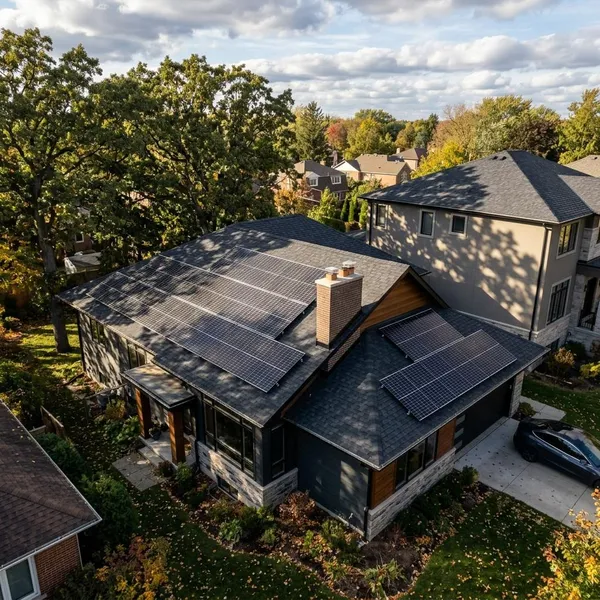
A simple roof with broad, sunny sections may match the calculation closely. A roof with shade, dormers, small planes, or several obstructions may need a different layout or a lower production target.
Roof space affects panel layout
Usable roof space matters more than total roof size. A typical residential panel may take roughly 17 to 22 square feet, so a 20-panel system may need about 340 to 440 square feet of usable area before layout limits are considered.
- Good fit: Large, open roof planes with few vents or obstacles.
- Harder fit: Small roof sections broken up by skylights, chimneys, dormers, or setbacks.
- Possible compromise: Higher-wattage panels or a lower offset target if the ideal count will not fit.
Roof angle and shading affect solar output
Roof direction and tilt influence yearly production, but shade is often the bigger deal. A decent east- or west-facing roof can still be useful, while a heavily shaded roof section may underperform even if it looks large enough.
Check shade during the productive part of the day, not just early morning or late evening. Trees, chimneys, neighboring buildings, and roof structures that cast shade around mid-day can change the system economics.
Weather affects yearly energy production
Cloud cover, snow, haze, dust, rainy seasons, and high heat can all reduce annual output. That does not make the calculation useless; it just means the peak sun hour and derate assumptions should match local conditions.
For a homeowner estimate, use average local solar data. For a final decision, compare installer production estimates and ask what weather data or shading model they used if the numbers look surprisingly high or low.
What Solar Calculation Mistakes Should You Avoid?
The most common mistakes come from using shortcuts that feel precise but miss the real sizing drivers. If your estimate starts with square footage, ignores losses, or forgets future electricity use, the final panel count can be misleading.
Using home size as the only estimate
A 2,000 sq ft home does not have a fixed solar panel count. One 2,000 sq ft home may use gas heating and modest electricity, while another may run central AC heavily, charge an EV, and use electric water heating.
Use house size only as a loose conversation starter. For an actual estimate, start with yearly kWh from your utility bills.
Ignoring system losses and efficiency
Skipping system losses is one of the fastest ways to undersize a DIY estimate. Panels are rated under controlled test conditions, while your roof deals with heat, dust, wiring losses, inverter conversion, and imperfect sunlight.
A derate factor gives you a more honest number. If two estimates are identical except one uses no loss adjustment, the no-loss estimate is usually the one to question.
Planning only for current energy use
Current use is the right starting point, but it may not be the right endpoint if your home is changing. A household planning to add an EV within a year should not size the system the same way as a household with stable electricity use and no major appliance changes planned.
Think in two buckets: electricity you use now, and electricity you can reasonably expect soon. Do not add vague "just in case" loads forever, but do include specific changes that are likely within the next few years.
Conclusion
A useful solar estimate starts with annual kWh, not guesses about panel count. Once you adjust for local sun, realistic losses, roof limits, and near-future electricity changes, you can tell whether an installer quote is sensible or whether the assumptions need a closer look.