
A solar panel's real output is best estimated by multiplying its rated wattage by local peak sun hours, then reducing the result for real-world losses such as heat, shading, inverter efficiency, dust, and wiring. The result gives daily watt-hours, which can be converted into kWh to compare with your electricity use, plan battery storage, or size a solar system accurately for your location.

What Does Solar Panel Output Mean?
Solar panel output is the electricity a panel produces over time. The number printed on the panel, such as 100W, 300W, or 400W, tells you its rated power under test conditions, not what it will deliver every hour on a roof, RV, shed, or cabin.
For planning, the useful number is usually energy in kilowatt-hours. That is the unit on most electricity bills, and it is the number you need when deciding whether one panel can charge a battery or whether a full roof array can offset a home's monthly use.
Measure the electricity a panel produces
A solar panel produces power moment by moment, but its real value is the total energy it makes across the day. A 400W panel may get close to 400 watts around bright midday conditions, then drop as the sun angle changes or clouds pass.
That is why inverter apps and solar calculators usually show daily or monthly kWh. If you are sizing a small off-grid setup, daily kWh matters most. If you are comparing a home system with your utility bill, monthly or yearly kWh is more useful.
Understand watts and kilowatt-hours
Watts measure the rate of production. Kilowatt-hours measure energy over time. One kilowatt-hour equals 1,000 watt-hours.
- 300W panel: the panel's rated power at one moment.
- 300W for 5 hours: 1,500Wh, or 1.5kWh, before losses.
- Utility bill: your household use shown in kWh, not watts.
This distinction prevents a common mistake: matching solar panels only to appliance wattage. A fridge, for example, cycles on and off, so its daily energy use matters more than its brief running wattage.
Compare rated and actual output
Rated output is tested under controlled conditions. Actual output is what you get after heat, roof angle, shading, dirt, inverter conversion, wiring, and weather reduce production.
For a rough home estimate, an efficiency factor around 0.75 to 0.85 is often more realistic than assuming perfect output. If you want a simple starting point, 0.8 is a practical middle value. Use a lower factor when there is regular shade, battery storage, or less-than-ideal placement.
How Do You Calculate Solar Panel Output?
The basic formula is:
Solar output per day (Wh) = panel wattage × peak sun hours × efficiency factor
Use peak sun hours, not total daylight hours. Five peak sun hours means the panel receives the equivalent of five hours of strong full sun, even if daylight lasts much longer.
- Find the panel wattage. Use the rated watts on the panel label or product sheet.
- Use local peak sun hours. A solar map or PV calculator is better than a broad national average.
- Choose a loss factor. Start with 0.8 for a normal grid-tied estimate, then adjust if shade or batteries are involved.
- Convert Wh to kWh. Divide watt-hours by 1,000 so the result matches your bill.
Calculate daily energy production
For daily output, multiply the three inputs directly. A 300W panel with 4.5 peak sun hours and a 0.8 efficiency factor gives:
300 × 4.5 × 0.8 = 1,080Wh per day, or 1.08kWh per day
For a weekend cabin or RV battery, this daily figure is the number to watch first. If your loads use 1.5kWh per day and your panel only makes about 1.08kWh, the system will slowly fall behind unless you add panel capacity, reduce use, or have another charging source.
Estimate monthly energy production
Monthly output is daily kWh multiplied by the number of days in the month. If one panel makes 1.6kWh per day, a simple 30-day estimate is 48kWh.
Use monthly output when comparing solar production with your bill, but do not treat every month as equal. A summer-only shed fan may be fine with an average estimate, while a year-round home system should be checked against weaker winter months too.
What Reduces Solar Panel Output?
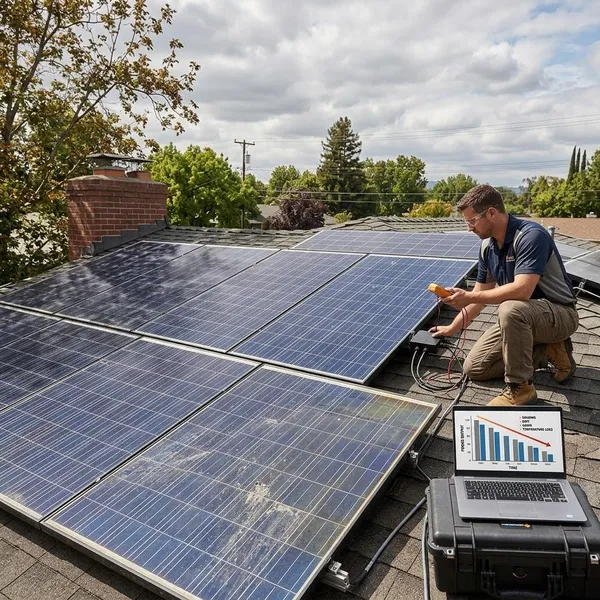
The biggest reasons solar output falls below the label are weak sunlight, shade, poor angle, heat, and system losses. If your first estimate looks too optimistic, check those items before assuming you simply need a different panel.
A good priority order is: sunlight first, shade second, then equipment losses. A slightly more efficient panel cannot fully fix a roof that is shaded during the best part of the day.
Weather and sunlight changes
Solar panels respond to sunlight intensity, not just daylight. Clouds, haze, smoke, snow cover, and shorter winter days can all reduce production. A location with 5.5 peak sun hours will usually produce far more than the same system in a location with 3.5 peak sun hours.
If you need solar for year-round use, check the lowest-production months rather than relying only on the annual average. That matters for off-grid cabins, winter battery charging, and homes trying to cover a high percentage of electricity use.
Poor placement and shading
Placement can change the result more than panel wattage. A shadow from a tree, chimney, vent, dormer, or nearby building can cut output during the exact hours when the panel should be producing the most.
- Best first check: look for shade between late morning and mid-afternoon.
- Roof direction: south-facing roofs often work well in the Northern Hemisphere, but southeast and southwest can still be useful.
- Layout issue: skylights, vents, and setbacks may reduce usable panel space.
How Much Power Do Different Solar Panels Produce?
The same formula works for every panel size. To make the numbers easy to compare, the examples below use 5 peak sun hours and a 0.8 efficiency factor. Your local result may be higher or lower, but the method stays the same.
| Panel or system size | Estimated daily output | Estimated monthly output | Best fit |
|---|---|---|---|
| 100W panel | 0.4kWh | 12kWh | Small battery charging, lights, compact devices |
| 300W panel | 1.2kWh | 36kWh | DIY arrays, partial home offset |
| 400W panel | 1.6kWh | 48kWh | Residential roofs with limited space |
| 2kW system | 8kWh | 240kWh | Small home, cabin, or meaningful bill offset |
Calculate output from 100W panels
A 100W panel using 5 peak sun hours and a 0.8 factor produces:
100 × 5 × 0.8 = 400Wh per day, or 0.4kWh per day
This is useful for light loads: LED lights, phone charging, a small fan, a router, or maintaining a modest battery. It is not a realistic choice for heavy appliances unless several panels and enough battery storage are added.
Calculate output from 300W panels
A 300W panel under the same assumptions produces about 1.2kWh per day, 36kWh per month, or 438kWh per year.
One panel will not cover a whole house, but several can become meaningful. Ten 300W panels create a 3kW array and would produce about 12kWh per day with these assumptions. That can cover a useful share of daytime consumption in an efficient household.
Calculate output from 400W panels
A 400W panel produces about 1.6kWh per day with 5 peak sun hours and a 0.8 factor. That works out to about 48kWh per month or 584kWh per year.
This size is often attractive when roof space is limited. If two panels have similar cost and fit the same roof area, the higher-wattage option may reduce the total panel count needed to reach your target.
Estimate output from small solar systems
For a small system, add up the total rated wattage first. A 2kW system is 2,000W of panel capacity, so the estimate is 2,000 × 5 × 0.8 = 8,000Wh, or 8kWh per day.
- 1kW system: about 4kWh per day, useful for modest loads or a partial offset.
- 2kW system: about 8kWh per day, enough to make a noticeable difference for a small home or cabin.
- 5kW system: about 20kWh per day, often a meaningful residential system in sunny conditions.
For temporary use, such as a seasonal workshop, an average summer estimate may be enough. For long-term home use, check annual and winter production before deciding the system is large enough.
How Many Solar Panels Do You Need?
The number of panels you need comes from three limits: your energy use, each panel's realistic yearly output, and the space where panels can actually fit. Start with your bill, not with the panel catalog.
A simple target calculation is:
Panels needed = annual kWh use ÷ estimated yearly kWh per panel
Calculate your energy needs
Check your electricity bill for kWh, not just the dollar amount. If your home uses 900kWh per month, that is about 10,800kWh per year.
Use a full year of bills if you can. One mild spring month can make your usage look lower than it really is, while a hot summer month may overstate your normal load. Add expected future use too, such as an EV charger, heat pump, pool pump, or home office equipment.
Match panel size to electricity use
If one 400W panel is estimated to make 584kWh per year and your home uses 10,800kWh per year, the rough count is:
10,800 ÷ 584 = 18.5 panels
In practice, that means at least 19 panels before adjusting for roof layout, shading, local rules, or the percentage of your bill you actually want to offset. If you only want to cover part of your use, size the system to that target instead of forcing a full offset.
Fit panels to available space
Roof space can stop a perfect spreadsheet design from working. Many residential panels use roughly 17 to 22 square feet each, but usable space is reduced by roof edges, vents, skylights, chimneys, fire setbacks, and shaded areas.
- Limited roof space: consider higher-wattage panels to get more output from fewer modules.
- Large open roof: you may have more flexibility to compare price per watt.
- Shaded roof sections: do not count them as full-production space without a careful shade check.
The best system is not automatically the biggest one. It is the one that fits the roof, produces at the right time of year, and matches the amount of electricity you realistically want to cover.
Conclusion
Calculating solar output is mostly about using the right inputs, not doing difficult math. Start with panel wattage, use local peak sun hours, apply a realistic loss factor, then compare the result with your actual kWh needs. If shade, batteries, or winter performance matter in your situation, estimate conservatively before buying more equipment or trusting a best-case number.