
An off grid solar system with generator backup gives you reliable power when solar panels and batteries handle everyday demand but cannot fully cover long cloudy periods, winter shortages, or brief high-load situations. The generator is best used as a backup tool, not the main energy source, helping protect the battery bank and avoid oversizing the solar array for rare conditions. A good setup starts with a clear look at daily energy use, seasonal sunlight, critical loads, battery capacity, and how much hands-on monitoring you are willing to manage.
Why Add a Generator to an Off Grid Solar System?
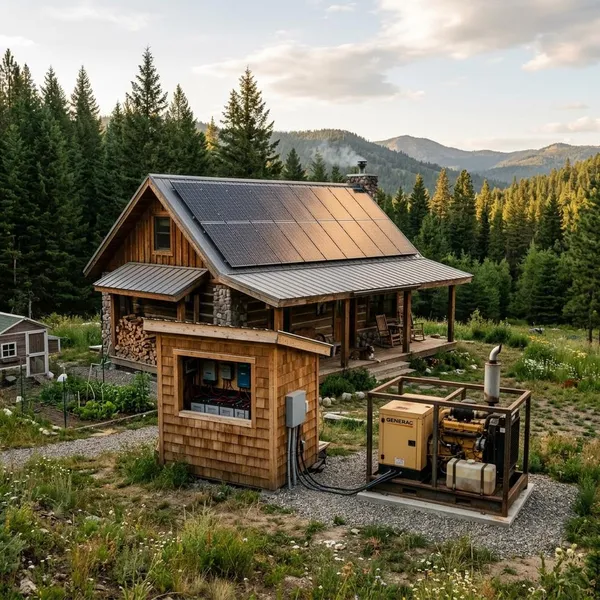
A generator makes an off-grid solar setup more forgiving. Solar panels and batteries can handle most normal days, but they are not always the cheapest way to cover the worst few days of the year.
The practical question is not "solar or generator?" It is how much you want to spend on panels and batteries before occasional generator use becomes the smarter backup layer.
It provides backup during low solar periods
Several cloudy days can drain a battery bank faster than expected, especially in winter or in areas with snow, smoke, heavy tree cover, or short daylight hours. A generator gives the system a way to recover before batteries stay too low for too long.
It supports high-power loads when needed
Some loads are awkward for batteries and inverters because they draw a lot of power for a short time. Well pumps, compressors, saws, large microwaves, and workshop tools can push a small system hard even if daily energy use looks reasonable on paper.
- Occasional heavy use: a generator can cover short spikes without oversizing the whole system.
- Daily heavy use: the solar array, inverter, batteries, and generator all need to be sized as one working system.
- Mixed household use: avoid running every large appliance while batteries are already low.
It improves reliability during long outages
In an off-grid setting, a "power outage" usually means the system has run out of stored energy or cannot keep up with demand. A generator adds a separate energy source that does not depend on sunlight.
This matters most when electricity supports water pumping, refrigeration, communications, remote work, heating controls, or health-related equipment. If losing power is only annoying, backup can be simple. If losing power creates real risk, generator integration deserves more careful planning.
How Does an Off Grid Solar System With Generator Backup Work?
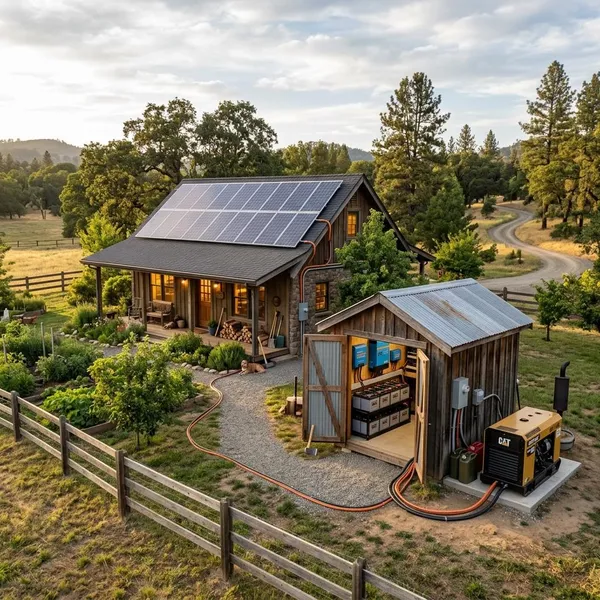
The system normally runs on solar first, stores extra energy in batteries, and uses an inverter to power AC loads. The generator steps in when batteries are low, solar production is weak, or a load is too large for the system to handle comfortably.
The exact behavior depends on the inverter/charger, charge settings, generator size, battery type, and whether the generator is started manually or automatically.
Solar panels charge the battery system
Solar panels produce DC power during daylight, and the charge controller manages how that power enters the battery bank. Real output is affected by shade, panel angle, season, dirt, snow, and local weather, so nameplate wattage should not be treated as guaranteed daily production.
The inverter supplies power to home loads
The inverter turns stored battery power into usable AC power for household circuits. It must be sized for both steady loads and startup surges, because pumps, refrigerators, freezers, and tools may briefly demand much more power than their normal running wattage.
A common mistake is sizing the inverter only from average daily energy use. That can leave the system with enough battery capacity but not enough surge capability to start important equipment reliably.
When Do You Need Generator Backup?
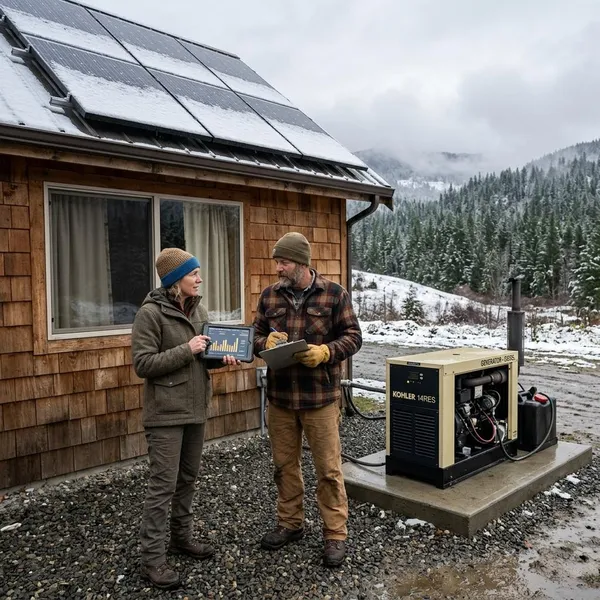
You need generator backup when the consequence of low batteries is more serious than a small inconvenience. If you can wait for the sun to return, backup may be optional. If low batteries mean no water, spoiled food, lost work, or unsafe conditions, backup should be part of the design.
A good first check is simple: list the loads you cannot comfortably lose for a full day, then compare that list with your weakest solar season.
Remote homes need reliable backup power
A full-time remote home has very little margin for an underbuilt system. Refrigeration, water pressure, internet, lighting, security, and heating controls may all depend on the same battery bank.
For this situation, solar-only can work, but it usually requires a larger and more expensive battery and panel setup. A generator often gives better resilience for the rare weeks when production drops and normal life still has to continue.
Low-sun periods need extra energy support
Low-sun periods are the most predictable reason to add backup. Winter, storms, wildfire smoke, snow cover, and shaded sites can reduce production for several days in a row.
If your system only fails during those periods, the fix may not be "buy everything bigger." It may be a better charging strategy, more realistic winter load planning, and a generator that can bring batteries back into a safe working range.
Heavy loads need additional power sources
Heavy loads need special attention because they can create problems even on sunny days. A cabin with lights and a fridge is very different from a property with a deep well pump, power tools, or a large pressure system.
- Separate daily loads from occasional loads. Do not size the whole system around a tool you use twice a month unless it is critical.
- Check overlap. Heavy loads during cloudy weather are harder on the system than the same loads on a sunny afternoon.
- Decide what can wait. If workshop work can be scheduled while the generator runs, you may save money on batteries and inverter capacity.
What Does an Off Grid System Cost?
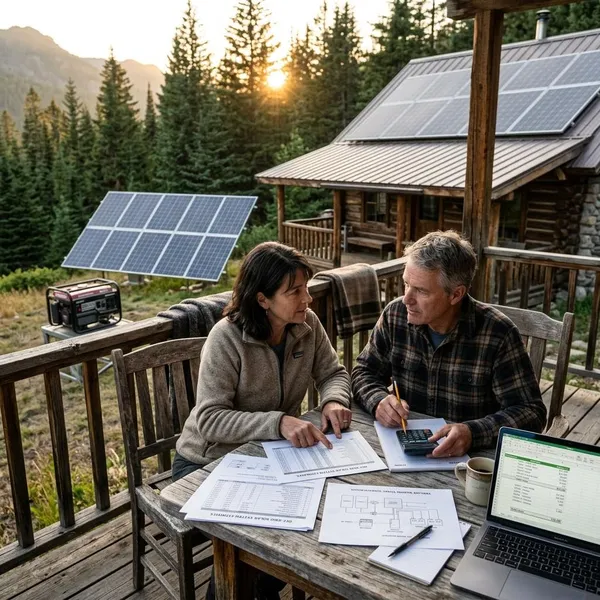
Cost depends on system size, battery chemistry, inverter quality, generator type, controls, installation complexity, and local labor. A small seasonal setup can be modest, while a full-time home with automatic backup and large battery storage can become a serious infrastructure project.
The cheapest design is not always the best value. A system that saves money upfront but runs the generator constantly or wears batteries quickly can cost more over time.
Equipment affects upfront investment
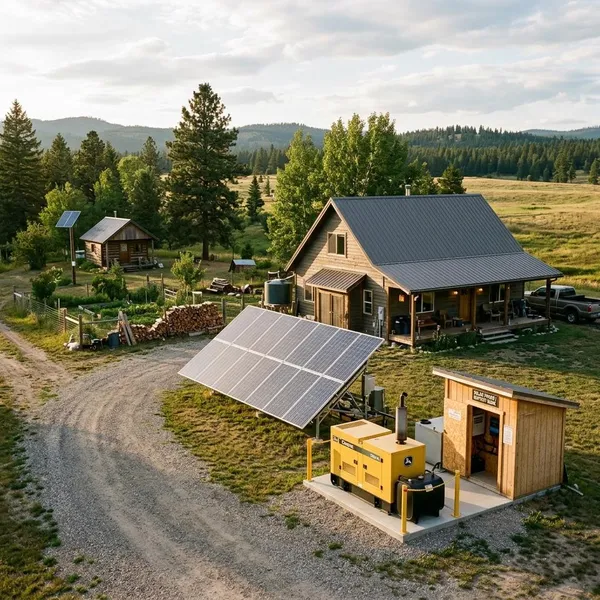
Main equipment costs usually include panels, racking, batteries, charge controllers, inverter/charger hardware, wiring, breakers, disconnects, grounding, monitoring, and the generator. Automatic start and more advanced control equipment add cost, but they may be justified when reliability matters.
Battery choice changes the budget quickly. Lithium batteries often cost more at purchase, but they usually provide more usable capacity and easier charging behavior. Lead-acid can still fit simpler or lower-cost systems, but it requires more careful management.
Which Setup Fits Different Off Grid Needs?
The right setup depends on how the property is used. A year-round home, a summer cabin, an RV, and a workshop can all use solar with generator backup, but they should not be built the same way.
Think first about occupancy, critical loads, heavy-load timing, and whether someone will be around to manage the system.
Full-time homes need automatic backup systems
Full-time homes usually justify stronger batteries, a reliable inverter/charger, careful surge planning, and automatic generator start. The system has to work on ordinary weekdays, winter mornings, and stormy nights, not just during ideal weather.
It is also worth reducing electric loads that are expensive to support off-grid. Electric resistance heating, large electric water heaters, and heavy air-conditioning use can push system cost up quickly unless the design is built around them from the start.
Cabins need simple flexible power
A seasonal cabin can often stay simpler. If the loads are lights, a small fridge, phone charging, a water pump, and occasional kitchen use, a manual-start generator may be enough.
The decision changes if the cabin is left unattended with loads running, used in freezing weather, or expected to feel like a full-time home. In that case, monitoring and automatic backup may be worth the extra cost.
RVs need compact mobile solutions
RVs have limited roof space, limited storage, and weight concerns. Solar may handle quiet daily loads such as lights, fans, electronics, and refrigeration, while the generator covers air conditioning, microwave use, or long stays in shade.
For boondocking, the better setup is usually not the one with the biggest generator. It is the one that lets you use battery power quietly most of the time and run the generator only when the load truly justifies it.
How to Choose the Right Off Grid Configuration?
Choose the configuration by working from loads to equipment, not the other way around. Buying panels, batteries, or a generator first can lock you into a system that looks impressive but does not match how power is actually used.
The most important priority is to cover normal daily use with solar and batteries, then decide which unusual conditions the generator should handle.
Match the system with your energy use
Start with a load list in kilowatt-hours per day, then mark which loads are critical, seasonal, or occasional. Do this separately for summer and winter if the property is used year-round.
- Check daily energy: refrigeration, lighting, internet, fans, pumps, appliances, and chargers.
- Check surge loads: well pumps, freezers, compressors, power tools, and motors.
- Check critical loads: anything tied to water, food storage, work, safety, or health.
If you do not know the exact numbers, use a plug-in meter for smaller appliances and equipment labels or professional load calculations for larger hardwired loads.
Balance solar size with generator dependence
Too little solar means frequent generator runtime. Too much solar and battery capacity can make the project unnecessarily expensive if it is only solving a few bad-weather days each year.
A practical balance is to let solar cover most normal use while sizing the generator for recovery periods and short heavy-load events. If the generator runs in ordinary weather, the system may be undersized or the household load may be higher than expected.
Choose automation based on your needs
Manual start is fine when someone is present, understands the battery monitor, and can choose when to run the generator. It keeps the system simpler and can be a good fit for cabins, workshops, and occasional-use properties.
Automatic start is worth considering when the system protects food, water, communications, security, or health-related loads. The extra cost is easier to justify when human attention is the weak point in the system.
Conclusion
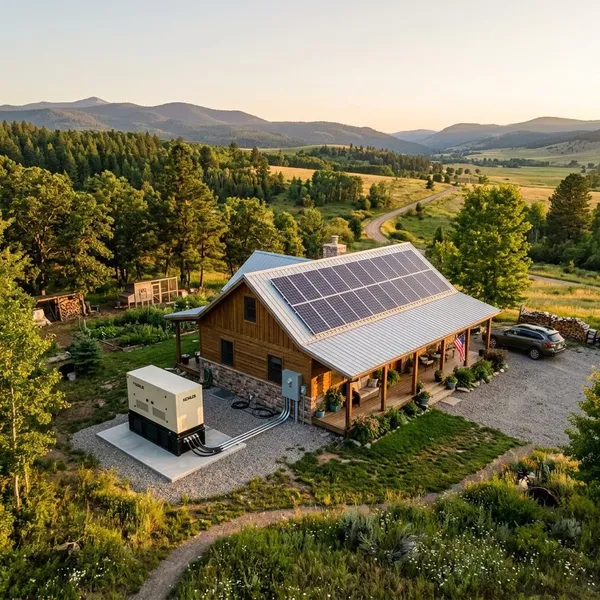
A well-designed off-grid setup uses solar and batteries for normal life and keeps the generator for the moments that would otherwise force an oversized or unreliable system. If your loads are light and flexible, backup can stay simple; if the property is full-time, remote, or supports critical equipment, plan the generator as part of the system from the beginning. The smartest choice is the configuration that handles your worst realistic conditions without making everyday operation expensive or complicated.