
A portable power station can run an air conditioner, but only if it clears two separate hurdles: enough inverter output to start the compressor and enough battery capacity to keep it running. For most people, a small window unit is the realistic choice; RV air conditioners and central AC usually need much more surge power, battery storage, or a different backup setup.
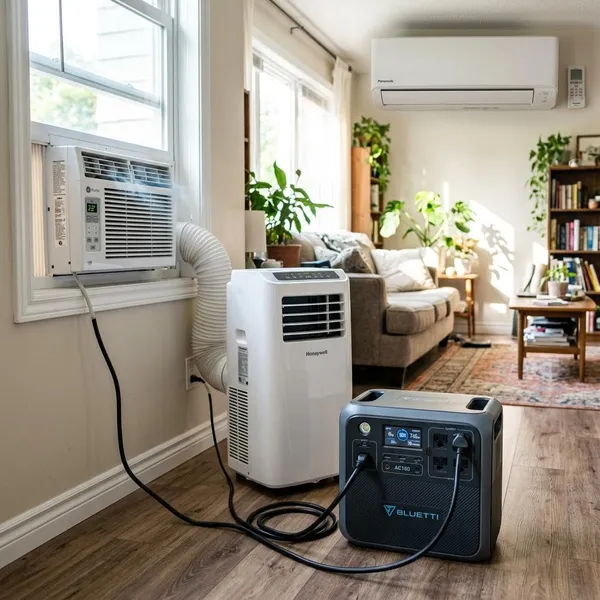
Which air conditioners can run on a portable power station?
The easiest air conditioners to run from a battery are small, efficient, and used to cool one room instead of a whole home. The harder ones have large compressors, high startup demand, or long runtime expectations.
Window AC units can work with smaller systems
For short outages or cooling a bedroom at night, a small window air conditioner is usually the most practical match. Many 5,000 to 8,000 BTU models run somewhere around 400 to 800 watts, although the exact number depends on the model, age, and efficiency rating.
- Best case: a newer 5,000 BTU unit in a closed room.
- Less ideal: an older unit with no clear wattage label.
- Main risk: startup surge that is much higher than running watts.
Portable AC units need more battery capacity
A portable AC is often harder on a battery than people expect. Many units draw roughly 900 to 1,500 watts while running, and because they are commonly used in warmer rooms or open spaces, the compressor may stay on for long stretches.
This can still make sense for temporary cooling, such as taking the edge off a room during a summer outage. For overnight use, the battery size climbs quickly, so it is worth calculating runtime before assuming a portable AC is the easier option.
Mini splits vary widely in power needs
Mini splits are not all the same. A small inverter-driven single-zone system may ramp up gently and use power efficiently, while a larger multi-zone setup can exceed what a typical portable battery can handle.
The useful check here is not the BTU rating alone. Look for the actual electrical input, running current, and startup behavior for your exact unit. If the system is hardwired rather than plugged into a standard outlet, portable power becomes a more involved setup and may need professional electrical advice.
RV air conditioners need high surge output
The hard part with an RV air conditioner is usually startup, not just runtime. A 13,500 BTU RV AC may run around 1,200 to 1,800 watts, but the compressor can demand a much higher surge for a moment when it kicks on.
If you are cooling an RV for a short afternoon break, a large power station with strong surge output may work. If you want all-night cooling in hot weather, battery alone often becomes expensive and heavy unless you also have shore power, solar input, generator backup, or a soft start device to reduce the startup spike.
Central AC systems need much larger systems
A central AC system is usually not a good target for a normal portable power station. Whole-home cooling can require several thousand running watts, a large surge rating, and a battery bank much bigger than the compact units people use for camping or emergency backup.
For a home outage, the more realistic plan is often to cool one closed room with a small window unit rather than trying to keep the central system running. That gives you a safer, cheaper, and more predictable backup cooling setup.
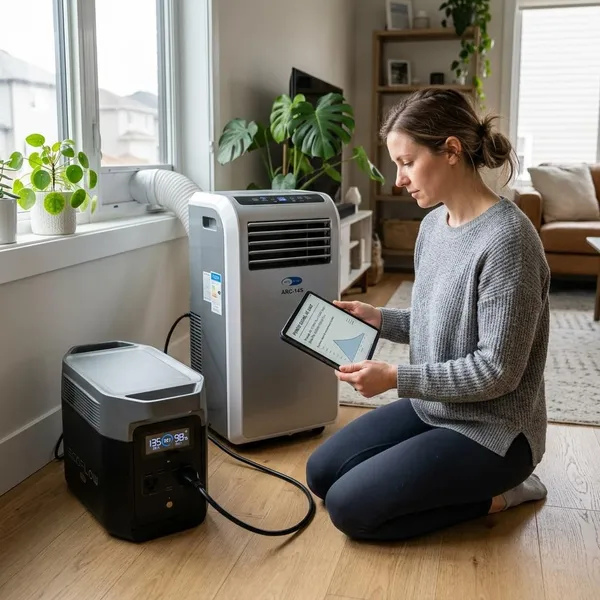
How do you size a power station for an air conditioner?
Start with the air conditioner, not the power station. The right order is running watts first, startup watts second, inverter rating third, and battery capacity last.
Check the AC running watts
Running watts tell you how much power the AC uses after it is already operating. You may find this on the label, in the manual, or in the product specifications.
If the label lists volts and amps instead of watts, estimate it this way:
- Find the voltage.
- Find the running amps.
- Multiply volts by amps.
For example, a 115V air conditioner drawing 5 amps uses about 575 watts while running. Treat that as a starting estimate, not a perfect real-world average.
Check the AC startup watts
Startup watts are the number that can make an otherwise reasonable setup fail. A unit that runs at 600 watts may briefly need 1,200 to 1,800 watts, and some compressors can spike higher.
If the power station cannot handle that momentary surge, the AC may click, trip the inverter, or fail to start. This is why buying only by watt-hours is a common mistake: a big battery still will not help if the inverter is too weak.
Match the power station output
The power station should have continuous output above the AC's running watts and surge output above the AC's startup demand. Do not size it right on the edge.
- Continuous rating: should comfortably exceed the running load.
- Surge rating: should clear compressor startup.
- Headroom: useful if you also run a fan, light, or charger.
If your AC runs at about 700 watts and may start at 1,600 watts, a unit rated around 1,000 watts continuous and 2,000 watts surge is a much safer match than one barely meeting the numbers.
Calculate the battery capacity
Battery capacity decides whether the setup is useful for minutes or hours. Multiply the AC's average watt draw by the number of hours you want, then add a buffer for inverter losses and real-world conditions.
For a simple estimate, a 600-watt average load for 4 hours needs about 2,400Wh before losses. In practice, adding roughly 15% to 25% gives you a more realistic target. If that number is far above your budget or carrying limit, the better move may be a smaller AC, a shorter cooling window, or another backup source.
How long will a power station run an air conditioner?
Runtime is never just the battery number printed on the box. Temperature, room size, insulation, inverter efficiency, and compressor cycling all change the result.
Battery capacity affects runtime
A larger battery gives you a longer cooling window, but the difference needs to be measured against your AC's actual load. A 500Wh station may only run a small window unit briefly, while a 2,000Wh or 3,000Wh unit can become useful during a short outage.
A quick estimate is:
Runtime = usable battery capacity ÷ average AC watts
So if you have about 2,000Wh usable and the AC averages 500 watts, the rough runtime is around 4 hours before adjusting for losses and cycling.
AC power draw affects runtime
A low-draw window unit in a closed bedroom is far easier to support than a large portable AC cooling an open living area. That is why narrowing the cooling target often helps more than buying a slightly bigger battery.
If your real goal is sleeping through a hot night, focus on one room, close the door, block direct sun earlier in the day, and use a fan to spread the cooled air. Those small choices can reduce how hard the compressor has to work.
Inverter losses reduce runtime
You will not get every watt-hour in the battery delivered to the air conditioner. The inverter and electronics use some energy, and a practical estimate is often around 10% to 15% loss, though the exact amount varies by unit and load.
Using 85% efficiency, a 2,048Wh battery gives about 1,741Wh of usable AC power. With a 600-watt air conditioner load, that works out to roughly 2.9 hours.
Compressor cycling changes runtime
An air conditioner does not always pull full power every second. Once the room reaches the set temperature, the compressor may cycle off and on, lowering the average draw.
That is why the same power station might feel fine on a mild evening and disappointing on a very hot afternoon. In high heat, poor insulation, or direct sun, assume the compressor will run more often and plan for shorter runtime.
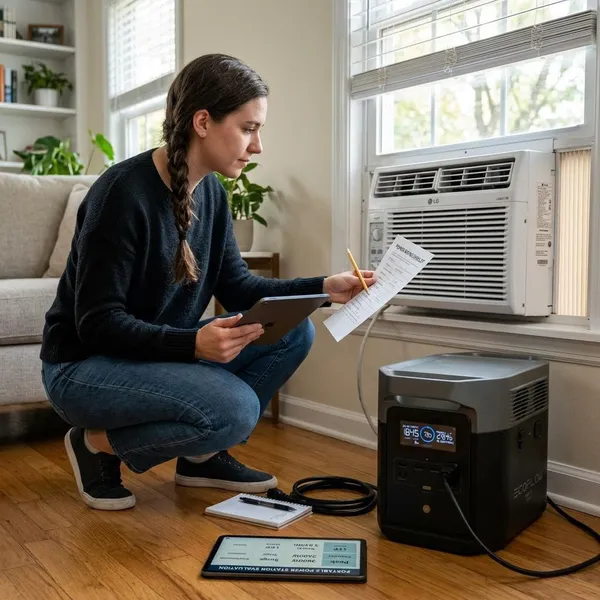
What should you look for in a power station for AC?
The best choice is not simply the biggest battery you can afford. For air conditioning, the inverter rating decides whether the AC can start, while the battery decides how long the cooling lasts.
Enough continuous output
Continuous output should be comfortably higher than the AC's running watts. If your AC runs at 800 watts, a 1,000-watt inverter may work on paper, but 1,200 watts gives more room for fluctuations and small extra loads.
Enough surge output
Surge output matters most when the compressor starts. If the surge rating is unclear, too low, or only advertised vaguely, be cautious with compressor-based air conditioners.
For RV units or older ACs that start hard, look into whether a soft start device is compatible. It will not reduce the energy needed for long runtime, but it may make startup much easier for the power station to handle.
Enough battery capacity
Choose battery capacity based on the cooling job you actually need. A short emergency setup for a small room may only need a few hours of runtime; regular overnight use in summer may require a much larger battery than expected.
- Temporary outage: prioritize reliable startup and a few hours of cooling.
- Overnight cooling: calculate watt-hours before buying.
- RV or off-grid use: plan for recharging, not just storage.
- Central AC backup: consider a larger installed system instead.
Conclusion
The most sensible portable power setup is usually built around a small, efficient air conditioner and a realistic runtime goal. Check running watts first, confirm startup surge second, and only then decide how much battery capacity is worth paying for; if the numbers point toward a huge system, cooling one room or using another backup option is often the better call.