
A portable power station can run an electric blanket, but the right size depends less on the outlet rating and more on battery capacity. For a few hours, a small unit may be fine; for overnight heat, you usually need a larger battery and a realistic estimate based on the blanket's watts, heat setting, and AC losses.
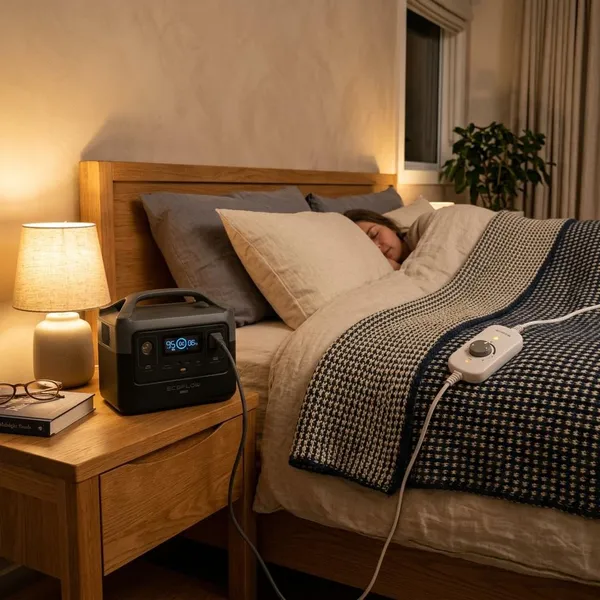
Can a portable power station run an electric blanket?
In most cases, yes. Electric blankets are much easier to power than space heaters, kettles, microwaves, or hair dryers. The part people often underestimate is not whether the blanket will turn on, but whether the battery will last long enough to be useful.
Most electric blankets have modest power needs
Many heated throws and electric blankets sit somewhere around 40 to 150 watts, depending on size and setting. That is a fairly gentle load for many modern power stations.
A small heated throw on the sofa during an outage is a very different use case from a queen-size blanket on high in a cold cabin. Both may "work," but the second setup will drain the battery much faster.
The power station must handle the blanket's wattage
Check the blanket label, controller, power adapter, or product page for its rated wattage. The power station's continuous AC output should be comfortably higher than that number, not barely equal to it.
- One low-watt blanket: a 200W to 300W AC outlet is often enough.
- Blanket plus small devices: allow extra headroom for a phone, lamp, or CPAP.
- Unknown blanket wattage: do not guess from blanket size alone; find the actual rating first.
Battery capacity determines runtime
Battery capacity, listed in watt-hours or Wh, is what decides whether you get a short warm-up or a full night. A 300Wh station and a 1000Wh station might both run the same blanket, but they will not run it for the same length of time.
For blanket use, think of output watts as the "can it power it?" number and watt-hours as the "how long will it last?" number. Runtime is usually the deciding factor.
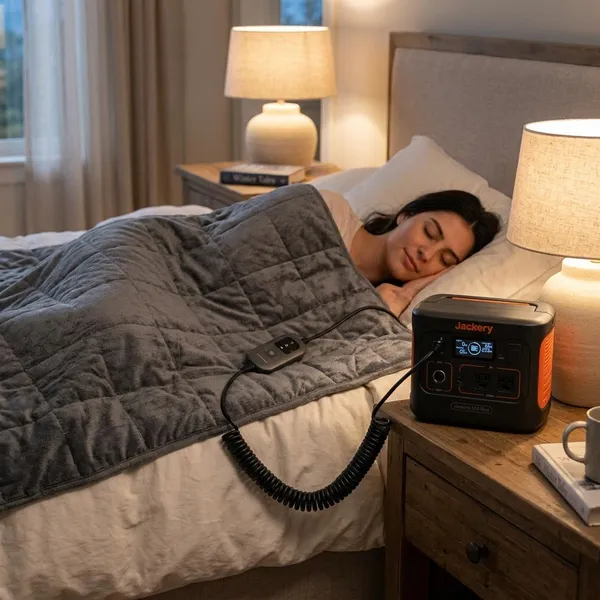
How much power does an electric blanket use?
Electric blanket power use changes with size, temperature setting, insulation, and whether the blanket runs from AC or DC power. The rated wattage is the safest starting point, but the average draw during real use may be lower once the blanket warms up.
Blanket size affects power use
Larger blankets usually draw more power because they heat more surface area. Dual-zone models can also use more energy, especially if both sides are running.
- Heated throw: often about 40 to 80 watts.
- Twin blanket: often about 60 to 100 watts.
- Full or queen blanket: often about 80 to 120 watts.
- King or dual-control blanket: often about 100 to 150 watts or more.
Treat these as rough ranges, not buying rules. The label on your own blanket matters more than a general estimate.
Heat settings affect power use
High heat usually pulls more power, especially during the first warm-up. A practical battery-saving habit is to preheat on a higher setting, then turn the blanket down once you are under covers.
That matters most when you are trying to stretch a medium-size power station through an evening or into the night. Leaving the blanket on high the whole time is one of the quickest ways to shorten runtime.
Thermostat cycling affects average use
Most electric blankets do not draw their maximum wattage every minute. After warming up, the controller may cycle the heating elements on and off to maintain temperature.
This is why a 100W blanket may average less than 100W in a well-insulated bed. In a drafty tent, cold vehicle, or poorly insulated room, it may cycle more often and use closer to its rated power.
AC and DC blankets use power differently
An AC blanket uses the power station's inverter, which converts battery power into household-style AC power. That conversion costs energy, so the full listed battery capacity is not usually available at the AC outlet.
A DC heated blanket can be more efficient if it is designed for the power station's DC output, but compatibility matters. Check the required voltage, connector type, and maximum current before assuming a car-style or 12V blanket will plug in safely.
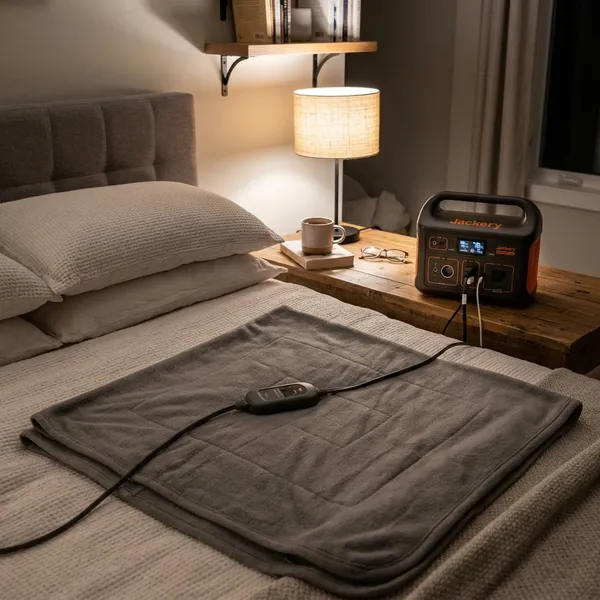
How long will a portable power station run an electric blanket?
The useful estimate is simple: compare usable battery capacity with the blanket's average wattage. You do not need a perfect calculation, but you do need enough margin for cold weather, higher settings, and inverter losses.
Check the battery capacity in watt-hours
Start with watt-hours, not the headline watt rating. A 500Wh power station stores roughly twice as much energy as a 250Wh model, even if both have an AC outlet that can handle the blanket.
For AC use, expect the usable number to be lower than the advertised battery capacity. The difference is normal and comes from inverter conversion and internal system overhead.
Check the blanket's wattage
Use the blanket's rated watts when you want a conservative estimate. If the label says 80W, calculate as if it may need 80W, then treat thermostat cycling as a possible bonus rather than something to rely on.
If you only plan to use a heated throw on low while watching TV, your average draw may be modest. If you are buying for winter camping, assume less forgiving conditions and size the battery with more cushion.
Account for inverter losses
For AC blankets, a reasonable planning estimate is often 80% to 90% usable capacity from the AC outlet. For example, a 500Wh battery might provide around 400Wh to 450Wh of usable AC energy.
This is also why two power stations with the same listed capacity can perform a little differently. Inverter efficiency, battery management, temperature, and age can all affect real runtime.
Calculate the estimated runtime
Use this formula:
Runtime = Battery Wh × Efficiency ÷ Blanket Watts
- Find the power station capacity in Wh.
- Use about 0.85 for a rough AC efficiency estimate.
- Divide by the blanket's expected watts.
- 300Wh station, 60W blanket: 300 × 0.85 ÷ 60 = about 4.25 hours.
- 500Wh station, 80W blanket: 500 × 0.85 ÷ 80 = about 5.3 hours.
- 1000Wh station, 60W blanket: 1000 × 0.85 ÷ 60 = about 14 hours.
If the estimate is close to the number of hours you need, move up a battery size or plan to use a lower heat setting. A tight calculation rarely feels generous in real cold weather.
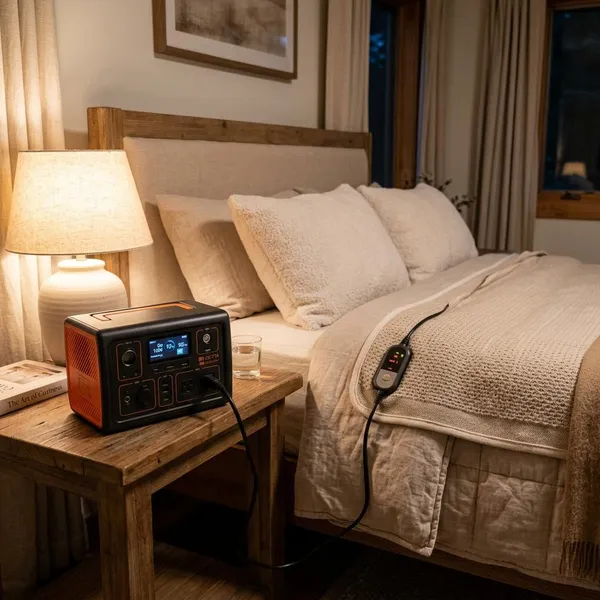
What size power station do you need for an electric blanket?
For electric blanket use, size the power station around your runtime goal. A short backup setup, an evening comfort setup, and an all-night camping setup should not be treated as the same purchase.
Small capacity for a few hours
A 200Wh to 300Wh power station can make sense for short, low-risk use: warming a bed before sleep, using a heated throw during a brief outage, or staying comfortable on the couch for a couple of hours.
It is not the best choice if you need dependable overnight heat. A small unit is easy to carry, but it leaves very little margin if the blanket draws more power than expected.
Medium capacity for evening use
A 400Wh to 700Wh station is often the more comfortable middle ground. It can suit evening use in a van, RV, guest room, or campsite, especially with a lower-watt blanket and sensible heat settings.
- Best fit: several hours of warmth without carrying a very large unit.
- Watch out for: queen or king blankets on high settings.
- Good habit: preheat, then lower the setting to stretch runtime.
Large capacity for overnight use
For all-night use, look more seriously at 800Wh to 1500Wh or more, depending on the blanket. A lower-watt heated throw may last through the night on a smaller large-capacity unit, while a bigger blanket on high may need much more.
If warmth is important for safety or health, do not size the system on a best-case calculation. Use the rated wattage, include inverter losses, and leave a buffer so the battery is not empty before morning.
How do you choose a portable power station for an electric blanket?
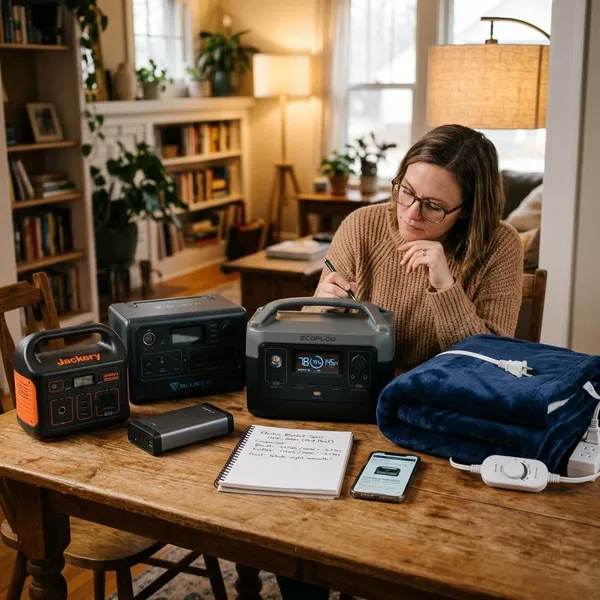
Choose in this order: battery capacity first, AC output second, then battery type, weight, and charging options. For an electric blanket, a huge inverter is less important than enough stored energy to cover the hours you actually need.
Choose enough battery capacity
Match capacity to the way you will use the blanket, not just to the cheapest model that can turn it on.
- 200Wh to 300Wh: short sessions or emergency warm-up.
- 400Wh to 700Wh: evening use or partial-night comfort.
- 800Wh and above: better starting point for overnight plans.
If your calculation says you need 480Wh, buying a 500Wh unit gives almost no room for losses, cold conditions, or battery aging. In that case, stepping up is usually the more practical choice.
Choose enough AC output
Most electric blankets do not need a massive inverter, but the AC outlet still has to exceed the blanket's rated draw. Add the watts for anything else you plan to run at the same time.
A common mistake is reading "300W" on the power station and assuming that means long runtime. It only tells you the outlet can supply up to that load; the Wh rating tells you how long the battery can support it.
Check battery type and lifespan
Battery chemistry matters more if you will use the power station often. Many newer models use LiFePO4 batteries, which commonly offer a longer cycle life than older lithium-ion designs, though exact lifespan depends on the brand and usage.
For occasional outage backup, a cheaper unit may be acceptable. For regular winter camping or frequent off-grid use, longer cycle life is worth paying attention to.
Consider weight and portability
More watt-hours usually means more weight. A compact 300Wh station may be easy to carry to a bedroom or car, while a 1000Wh unit can feel like something you plan around.
If you are camping from a vehicle, weight may not bother you much. If you are carrying gear to a tent or moving the unit between rooms during an outage, check the actual weight and handle design before buying.
Consider charging options
Charging options matter when the power station is part of a longer trip or backup plan. Wall charging is convenient at home, but car and solar charging can be useful when you are away from outlets.
- Fast wall charging: useful before storms or last-minute trips.
- Car charging: helpful during travel days.
- Solar input: useful off-grid, but weather-dependent.
- Pass-through use: check the brand's guidance before relying on it.
Conclusion
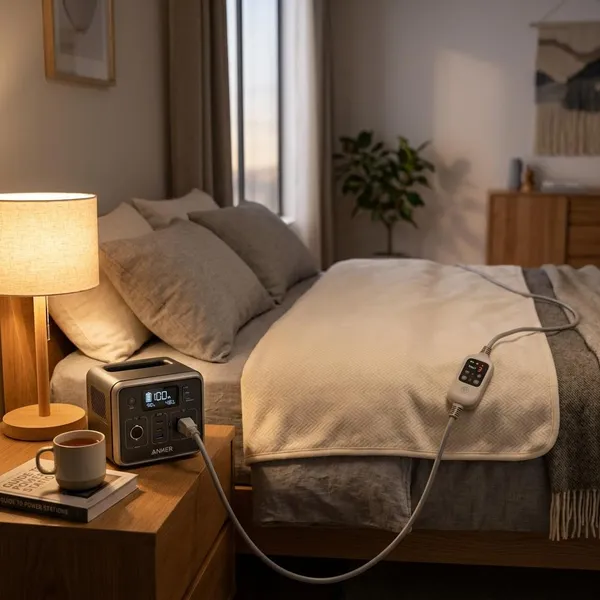
For a short warm-up or a few cozy hours, a small power station can be enough; for overnight use, battery capacity becomes the real deciding factor. Check the blanket's watts first, estimate runtime with AC losses included, and leave extra margin if the setup is for cold-weather camping, outages, or anyone who cannot afford to wake up without heat.