
Solar panel systems with battery storage are most valuable when they solve a specific household need: keeping essential appliances running during outages, reducing reliance on expensive evening electricity, or storing excess solar power when export credits are low. For homes with a reliable grid and generous solar buyback rates, a battery may not deliver enough added value right away, making a standard solar system a more cost-effective starting point.
How Does a Solar Plus Battery System Work?
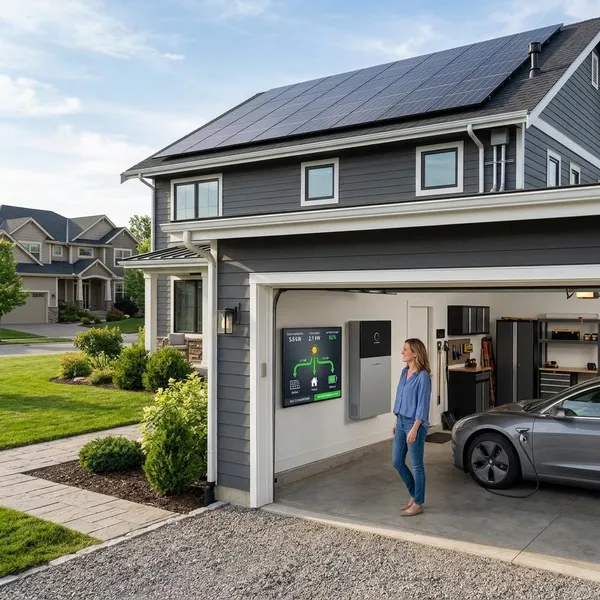
A solar plus battery setup moves electricity between four places: the solar panels, the home, the battery, and the grid. The system usually powers the home first, charges the battery with surplus solar, then uses the battery later when solar production drops.
The details depend on the inverter, battery controls, utility rules, and whether backup equipment is included. For a homeowner, the most important question is not the wiring diagram; it is what the system will do on a normal day and what it will do when the grid fails.
Solar panels generate electricity during the day
Solar panels produce electricity when sunlight hits them, and the inverter converts that power into a form your home can use. During sunny hours, active loads such as a refrigerator, laptop, pool pump, or air conditioner may use solar electricity directly before any surplus goes to the battery.
Production is not flat all day. Shade, cloudy weather, roof direction, winter sun, and late-afternoon demand all affect how much extra energy is available to store. This is why two homes with the same battery can get very different results.
The battery stores unused solar energy
The battery charges when your panels produce more electricity than the home is using. Capacity is measured in kilowatt-hours, which tells you how much energy the battery can hold; output is measured in kilowatts, which tells you how much power it can deliver at one time.
- Capacity matters for runtime: how long essentials can stay on.
- Output matters for large loads: whether appliances can start and run.
- Reserve settings matter: how much energy is saved for outages instead of daily use.
The home uses stored power at night
After sunset, the battery can discharge to support normal evening loads. A light-use household may stretch stored energy through much of the night with refrigeration, lights, internet, and device charging. A home using electric heat, heavy cooking appliances, or air conditioning may drain the battery much faster.
What Types of Solar Battery Systems Are Available?
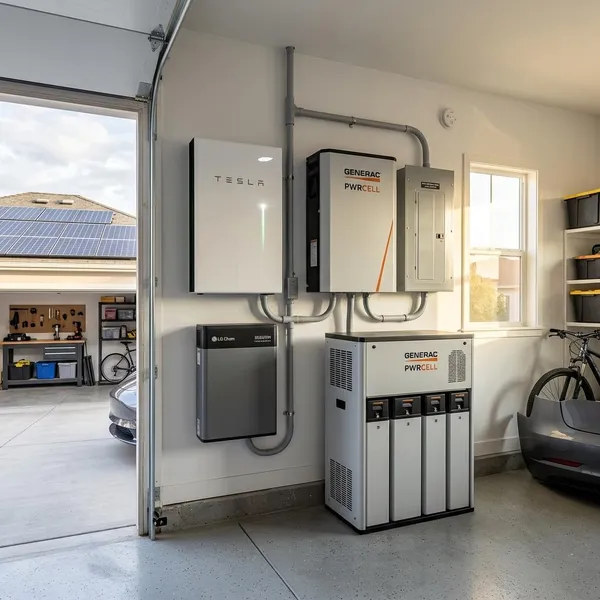
The main choices are grid-tied, hybrid, and off-grid systems. They can all include solar panels and batteries, but they handle utility power and backup in different ways.
Grid-tied systems combine solar with utility power
A grid-tied system remains connected to the utility. It can use solar power, charge a battery, export excess energy if allowed, and import grid power when the home needs more than the panels or battery can provide.
Do not assume "battery included" means "whole-home backup included." Some grid-connected battery systems are mainly configured for self-consumption or time-of-use savings. If outage protection matters, the proposal should clearly state which circuits are backed up and what equipment handles grid isolation.
Hybrid systems add battery backup and control
Hybrid systems are often the most flexible choice for homes that want both daily solar use and backup capability. A hybrid inverter or control system coordinates solar production, battery charging, grid use, and backup behavior.
This is usually the better fit for a homeowner who says, "I want lower bills, but I also need the fridge, Wi-Fi, lights, and a few outlets to keep working during outages." It may cost more than a simpler solar-only setup, but the added control is exactly what makes the battery useful.
Off-grid systems operate without the grid
Off-grid systems are built for homes, cabins, farms, or remote sites without utility service. In that situation, the battery is not an upgrade; it is part of the basic power supply.
Because there is no grid fallback, off-grid systems need more conservative sizing. They often require more solar capacity, more stored energy, careful load planning, and sometimes a generator for long cloudy stretches. For most suburban homes with a stable grid connection, going fully off-grid is usually more complexity than benefit.
Is Solar Battery Storage Worth It for Your Home?
Solar battery storage is worth considering when it solves a problem you can clearly name. The strongest cases are frequent outages, high evening electricity prices, weak solar export credits, or a household need for quiet automatic backup.
It works best for frequent outages
Battery storage becomes much easier to justify if blackouts are common where you live. A family dealing with storm outages several times a year may value automatic backup far more than a household that loses power once every few years for an hour.
It is especially useful when the outage affects something that cannot wait: a home office, a sump pump, refrigerated medicine, security equipment, or medical support devices. In those cases, the value is not only financial; it is avoiding disruption at the wrong moment.
It works best with high electricity costs
High electricity prices can make a battery more attractive, especially when expensive hours happen after solar production has dropped. If your home uses a lot of power in the evening, stored daytime solar may reduce purchases during the worst-priced part of the day.
Ask for a savings estimate that separates solar savings from battery savings. That makes it easier to see whether the battery is doing meaningful work or simply making the total project look more advanced.
It may not be needed for simple solar use
A battery may not be necessary if your main goal is lowering bills, your grid is dependable, and your utility still gives strong credit for exported solar. In that situation, a solar-only system can be cheaper, simpler, and easier to justify financially.
One practical approach is to install solar with battery-ready equipment if storage might make sense later. That can be useful if rates change, export credits drop, or outages become more common, without forcing you to buy batteries before there is a clear need.
What Can a Solar Battery System Power?
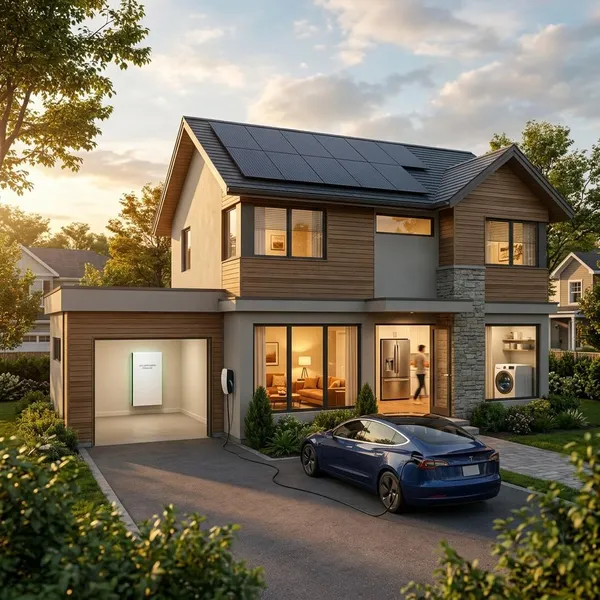
A solar battery system can power the circuits it is connected to, but runtime depends on battery capacity, battery output, and what is running at the same time. The most reliable designs start with essential loads instead of trying to make the whole home behave as if nothing happened.
It supports essential home devices
Most residential batteries are well suited to modest essential loads such as refrigerators, freezers, LED lights, routers, laptops, phone chargers, garage door openers, and selected medical equipment. These are the loads that usually give the best backup value per dollar.
- Good backup targets: food storage, communication, lighting, small electronics.
- Worth checking carefully: sump pumps, well pumps, medical devices, heating controls.
- Usually not first priority: dryers, ovens, EV chargers, large comfort loads.
It has limits with high-power appliances
Large appliances can be difficult because they may need both high startup power and a lot of stored energy. Central air conditioners, electric ovens, clothes dryers, electric resistance heat, and some pumps can exceed what a smaller battery and inverter can comfortably provide.
If one large load matters, such as air conditioning in a hot climate or a well pump on a rural property, mention it before the system is designed. The installer may need load controls, a soft-start device, a larger inverter, more batteries, or a different backup plan.
It can provide partial or whole-home backup
Partial-home backup is usually the most practical choice. It protects selected circuits and makes the battery last longer. Whole-home backup is possible, but it often requires multiple batteries, higher output equipment, and a willingness to manage large loads during longer outages.
A good decision rule is simple: if you want to keep life manageable, back up essentials. If you want the home to operate almost normally, budget for a larger system and expect more design work. Homes with electric heating, multiple AC units, or EV charging should be especially careful about whole-home claims.
Solar Only vs Solar Plus Battery vs Generator
Solar-only, solar plus battery, and generators solve different problems. Solar-only is usually best for lowering electricity bills. Solar plus battery adds quiet stored power and better self-use. A generator is still useful when you need high output for long outages.
| Option | Best fit | Main tradeoff |
|---|---|---|
| Solar only | Lower bills with the lowest system complexity | Usually no outage power |
| Solar plus battery | Quiet backup and better use of solar energy | Higher upfront cost and limited stored energy |
| Generator | Long outages or heavy loads | Fuel, noise, exhaust, and maintenance |
Solar plus battery provides quiet backup power
Solar plus battery backup is quiet, automatic when configured correctly, and does not require fuel handling during normal use. That makes it appealing in neighborhoods where generator noise, exhaust, or fuel storage would be a problem.
The limitation is stored energy. Batteries are excellent for short outages, overnight essentials, and daily load shifting, but they need careful management during multi-day outages with heavy loads.
Generators provide higher output with fuel
Generators can be the better tool for large homes, long outages, and heavy appliances. A standby generator may handle central air, well pumps, or other big loads more easily than a modest battery system.
The tradeoff is ongoing responsibility. Fuel supply, maintenance, noise, exhaust placement, and local rules all matter. For some homes, the strongest setup is a battery for quiet short outages and a generator for rare extended emergencies.
Solar-only systems cost less but lack backup
Solar-only systems usually cost less than solar paired with batteries and can be a smart choice when the goal is simple bill reduction. They are also less complex to design and install.
The key drawback is outage behavior. Most standard solar-only systems shut down when the grid goes down, so rooftop panels alone should not be treated as a backup power plan.
Conclusion
The best reason to add battery storage is a specific need: backup for important circuits, better control over expensive evening power, or less dependence on weak solar export credits. If none of those apply, solar-only may be the cleaner financial choice. Start with the loads you truly need to protect and the rate problem you are trying to solve, then size the system around that instead of buying the largest battery package by default.