A solar powered generator for tiny house living can work well if you size it around your real daily loads, not the biggest number on the product page. Check three things first: how many watt-hours you use in a day, the highest wattage you need at one time, and whether your panels can refill the battery fast enough for your climate and routine.
How Does a Solar Generator Work in a Tiny House?
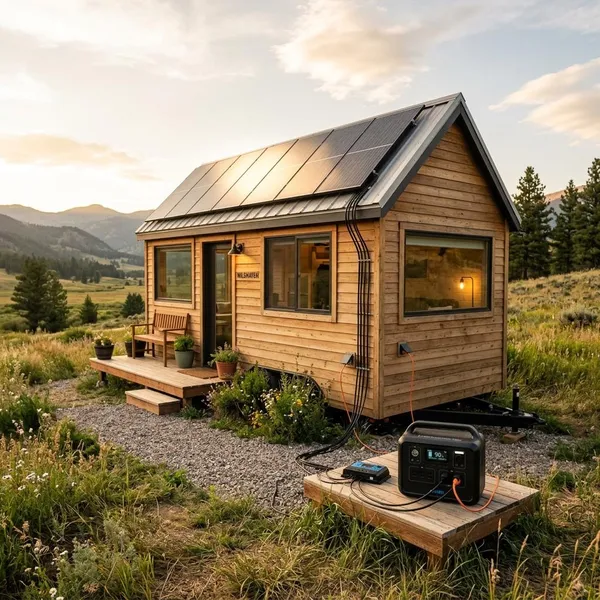
A solar generator for a tiny house is usually a portable power station paired with solar panels. The panels collect energy, the battery stores it, and the inverter turns that stored energy into usable household electricity.
The appeal is simplicity. For a tiny home on wheels, a weekend cabin, or a backyard studio, one unit can often cover lights, device charging, internet gear, a fan, and sometimes a compact refrigerator without the noise and fuel handling of a gas generator.
Capture solar energy with panels
Solar panels send power into the generator's charge controller during daylight hours. They can be mounted on the roof, placed on the ground, or used as folding portable panels that you move toward the sun.
Panel output is rarely perfect in real life. Shade from one tree, a low winter sun angle, or a cloudy week can cut charging enough to change the whole setup. If your tiny house sits in an open sunny spot, 400 watts of panels may feel very different from the same 400 watts under partial shade.
Store power in a battery
The battery is your reserve for evenings, storms, and low-sun days. Capacity is measured in watt-hours, so a 2,000Wh battery can theoretically supply 200 watts for about 10 hours before efficiency losses and reserve limits are considered.
For daily tiny house use, lithium iron phosphate batteries are often worth considering because they are commonly used for frequent charging cycles and longer service life. If the generator is only for occasional backup, battery longevity may matter less than price and portability.
Deliver electricity through an inverter
The inverter decides what the generator can run at the same time. A large battery with a weak inverter may store plenty of energy but still fail when a fridge compressor, microwave, pump, or power tool needs a startup surge.
This is where many buyers make the wrong comparison. Battery capacity affects runtime; inverter output affects whether an appliance will start and keep running safely.
How Do You Choose the Right Solar Generator Size?
Start with your loads, then choose the generator. A tiny house used on weekends for lights and phone charging needs a very different setup from a full-time off-grid home with refrigeration, remote work equipment, a water pump, and year-round weather demands.
The safest order is battery first, inverter second, solar input third. If one of those three is too small, the system will feel limited even if the other numbers look impressive.
Match battery capacity to your energy needs
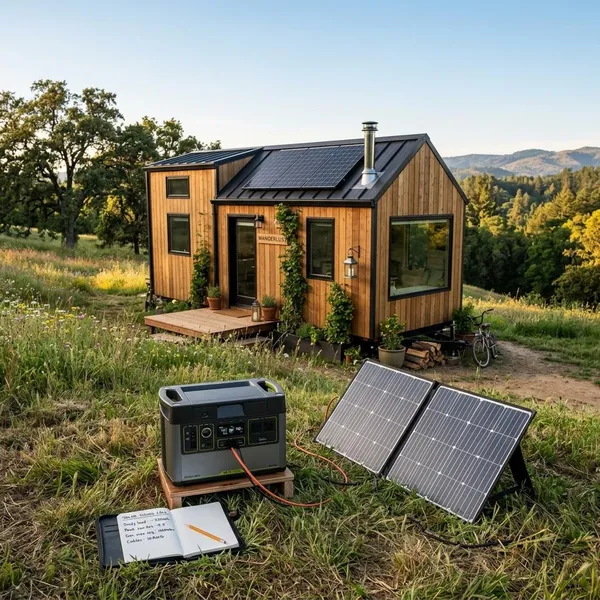
List each appliance, its wattage, and how many hours you use it per day. Add the watt-hours together, then add a buffer for overnight use and cloudy weather.
| Use case | Typical battery range | Best fit |
|---|---|---|
| Light backup | 500Wh to 1,000Wh | Phones, lights, laptop, router, short fan use |
| Practical tiny house essentials | 1,500Wh to 3,000Wh | Lights, devices, internet, compact fridge, limited kitchen use |
| Full-time off-grid comfort | 3,000Wh+ | More overnight reserve, cloudy-day cushion, fewer daily compromises |
A smaller unit can be fine for a summer-only cabin where you mostly cook with propane and use power at night. For a full-time tiny house in winter, the same unit may feel frustrating because short days and longer indoor hours increase demand.
Match inverter output to your appliances
Look at continuous wattage and surge wattage, not just battery size. A 1,000-watt inverter may handle laptops, lights, and a small fridge, but it can struggle if a microwave, kettle, pump, or compressor starts while other loads are already running.
- Low-demand setup: lights, charging, router, fan, laptop.
- Moderate setup: compact fridge, water pump, small kitchen appliance used briefly.
- High-demand setup: air conditioning, electric heating, induction cooking, hair dryer.
If you want fewer daily power rules, a stronger inverter is usually more valuable than a slightly larger battery on a weak unit.
What Can a Solar Generator Run in a Tiny House?
A well-sized solar generator can run many daily essentials, but it should not be treated like unlimited household power. The practical approach is to protect your essential loads first, then decide which comfort appliances are worth the battery drain.
Think in two groups: devices that can run for hours without much stress, and appliances that are fine only in short bursts or with a much larger system.
Run small electronics and appliances
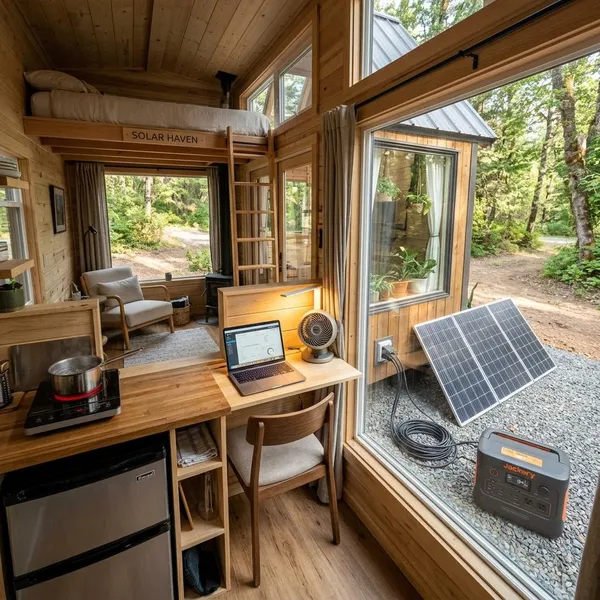
Small electronics are where solar generators feel easiest. Phones, tablets, laptops, LED lights, routers, cameras, small fans, and similar devices use modest power compared with heating or cooking appliances.
For a remote-work tiny house, this can be enough to make the system worthwhile even before adding bigger loads. A laptop, router, lights, and phone charging are predictable, easy to calculate, and usually friendly to battery-based power.
Power refrigerators and essential devices
Many solar generators can run a compact, efficient refrigerator, but the generator must handle both the compressor's startup surge and the long runtime across the day and night.
A fridge is usually a priority load because it runs in cycles and protects food. Pairing it with low-draw essentials such as LED lights, a router, and a small fan is realistic on a mid-size system; pairing it with frequent electric cooking or cooling is where the battery can drain quickly.
Should You Choose a Solar Generator or Another Power System?
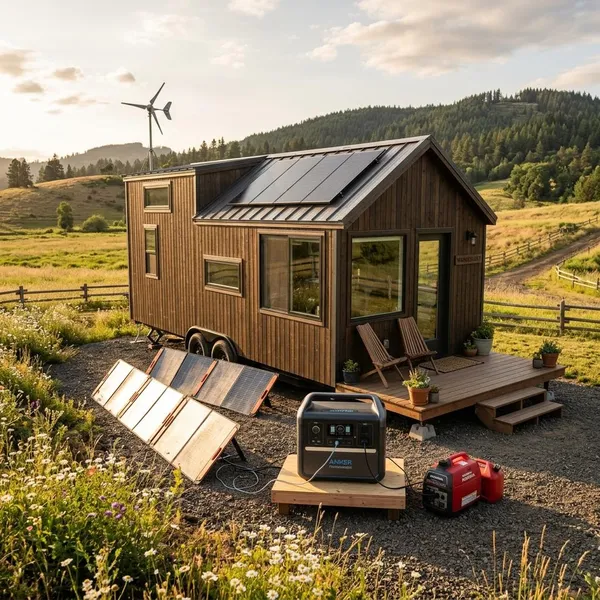
A solar generator is best when you want quiet, portable, low-maintenance power without designing a full electrical system. It is not always the best choice for heavy loads, permanent wiring, or year-round full-time off-grid living.
The decision usually comes down to simplicity versus capacity. Portable solar generators are easy to start with; gas generators provide more instant output; custom solar battery systems offer the most control but require more planning.
Choose solar generators for simple portable power
Choose a solar generator when your main goal is easy power for essentials. It works especially well for a tiny house on wheels, a part-time cabin, or a backup setup where you want to avoid fuel storage and engine noise.
The all-in-one design also reduces wiring decisions. Battery, inverter, charge controller, outlets, and monitoring are usually built into one unit, which makes the learning curve much easier for beginners.
Choose gas generators for higher output
A gas generator makes more sense when you need high output for tools, heavy appliances, or long runtime as long as fuel is available. It can be a useful backup for rare high-demand situations.
The trade-offs are serious in a tiny house setting: exhaust, noise, fuel storage, maintenance, and the need to run it outdoors away from living areas. It may solve a power problem, but it does not always fit quiet daily living.
How Do You Set Up a Solar Generator in a Tiny House?
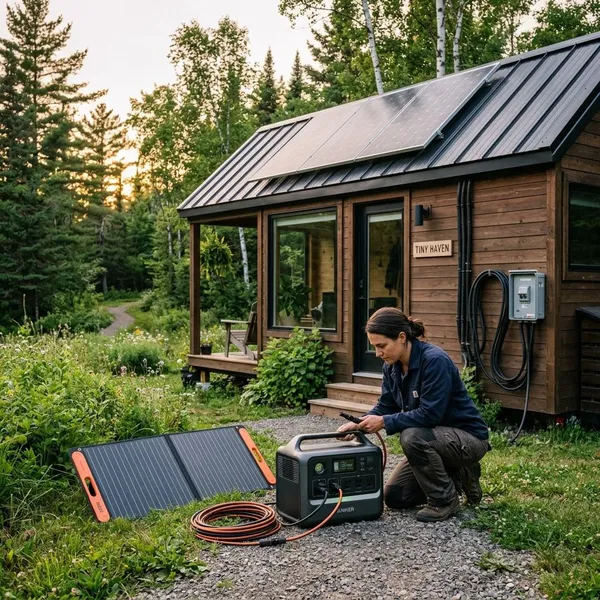
The simplest setup is to keep the generator portable and plug devices directly into it. A more permanent setup can be cleaner day to day, but it also increases the need for proper wiring, transfer equipment, and electrical protection.
Before mounting panels or planning outlets, decide how the generator will be used: emergency backup, part-time off-grid support, or daily primary power. That one decision changes how much safety margin and installation planning you need.
Connect larger systems safely
If you want the generator to feed built-in outlets or dedicated circuits, treat it as part of the home's electrical system. That may require an inlet, transfer switch, subpanel, breakers, disconnects, or other equipment chosen for the specific setup.
The main mistake to avoid is unsafe backfeeding. Plugging a generator into house wiring without proper transfer protection can create shock and fire risks, so this is the point where an electrician familiar with small off-grid or mobile systems is usually worth the cost.
Follow basic electrical safety
Stay within the manufacturer's limits for solar input, outlet load, temperature, and cable type. Do not cover the unit, overload power strips, use damaged cords, or place the generator where condensation or rain can reach it.
A tiny house leaves less room for sloppy wiring and heat buildup. Clean cable routing, easy access to shutoffs, and a habit of checking load before turning on high-power appliances can prevent most avoidable problems.
Conclusion
The right choice is the one that matches your smallest non-negotiable routine: keeping food cold, lights on, devices charged, and essential equipment running without constant battery anxiety. If your loads are modest, a portable solar generator can be a smart and flexible solution; if you expect electric heating, air conditioning, or full-time household comfort in every season, plan for a larger system before you buy.